

You found a website that talks about AI for business. It looks professional, the articles sound confident, and some pages even describe features and benefits. Then a doubt appears: is Droven.io legit, and can you trust it with your time, money, or company data?
It is a smart question. The AI market is crowded, and new tools and websites appear every week. Some are excellent. Some are thin marketing pages. Some are not what they claim to be. This guide explains what public information says about Droven.io, why the answer is not as simple as yes or no, and how to vet any AI business tool using a practical checklist you can reuse.
If you want the bigger picture on using AI in your company, read our pillar guide first: Droven.io AI for Business: What It Is and How to Use AI in Your Company (https://bytebenz.com/droven-io-ai-for-business/).
Quick Answer: Is Droven.io Legit?
Based on publicly available coverage, Droven.io is most commonly described as a content website that publishes articles about AI, automation, cloud computing, and digital transformation. Several independent write-ups describe it as an editorial and educational resource, not a software vendor with a sign-up flow, pricing plans, or its own AI model.
At the same time, other pages online describe Droven.io as a business intelligence or AI automation platform with dashboards and analytics. These descriptions conflict with the editorial one, and many appear on low-authority or republished-style sites that do not show verifiable product details.
So the fair answer is this: a content website existing is not a scam in itself, but you should not assume it is a software product you can buy. Information about it is inconsistent, so verify everything yourself before you pay for anything, create an account, or share business data. We cannot verify every claim made about any site, which is exactly why the checklist below matters.
Why “Is It Legit?” Is Often the Wrong First Question
Most people ask whether a site is legit or fake. In reality there are more categories than that. When you evaluate an AI website or tool, it usually falls into one of these groups:
A Real Software Product
A company that sells software, with a product page, pricing, documentation, support, and a way to sign up or request a demo.
A Content or Education Site
A publisher that explains AI concepts, reviews tools, and shares tutorials. It may be useful and honest, but it is not selling you software.
An Affiliate or Lead-Generation Site
A site that recommends tools mainly to earn commissions or collect your contact details. It may still be useful, but its incentives are different.
A Low-Quality or Misleading Site
A site that publishes vague or copied content, makes big claims without proof, or imitates real brands.
Once you know which category you are dealing with, you can decide how much to trust it and what to expect. A content site can teach you a lot. It just should not be treated as a vendor.
Why Confusion Around AI Tools Is So Common
There are several reasons you may find conflicting information about a name like Droven.io.
- Search-driven articles: Many sites write about a keyword simply because people search for it, not because they have tested or used a product.
- Republished content: The same article can appear on several sites with slightly different wording, which makes one claim look like many independent confirmations.
- Fast-moving market: Tools launch, rebrand, merge, and shut down quickly, so older articles go out of date.
- Marketing language: Phrases like “revolutionary,” “game-changing,” and “all-in-one” sound impressive but prove nothing.
The lesson is simple. Do not count how many pages repeat a claim. Look for primary evidence: the vendor’s own product pages, documentation, legal pages, and independent user reviews.
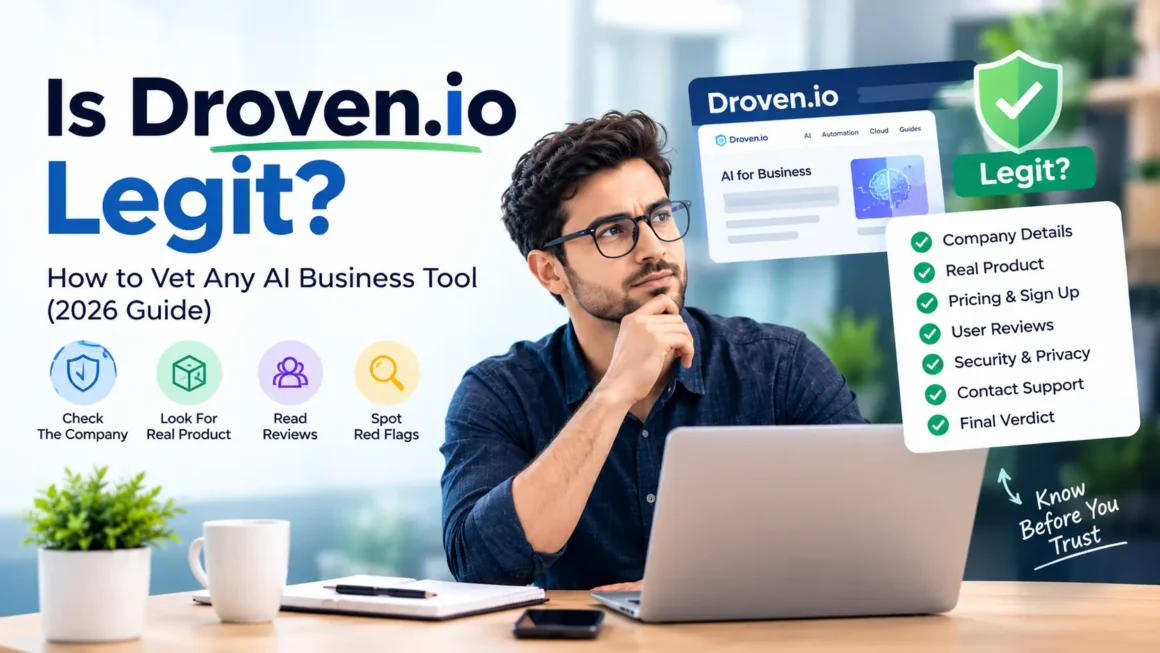
The 10-Point Checklist to Vet Any AI Business Tool
Use this checklist for Droven.io, for any tool you read about in an article, and for any AI product a salesperson pitches you.
1. Define the Problem First
Before you look at any tool, write one sentence about the business problem. For example: “Our team spends eight hours a week summarizing customer calls.” A clear problem gives you a yardstick. If a tool cannot clearly address it, move on, however impressive it looks.
2. Confirm There Is a Real Company Behind It
Look for a named company, a business address or registered entity, and identifiable team members or leadership. Check the About page and the Contact page. A real vendor wants to be reachable. If the only contact method is a generic form with no company details, treat that as a warning sign.
3. Look for an Actual Product
A legitimate software product usually has all of these:
- A product or features page that explains what it does in specific terms
- A sign-up, free trial, or demo request option
- Pricing, or at least a clear way to get a quote
- Documentation or a help center
- A login page for existing customers
If a site talks about “the platform” repeatedly but offers no way to use it, that is a strong signal it may be content only.
4. Check Independent Reviews
Search for the tool on review platforms such as G2, Capterra, and Trustpilot. Read recent reviews, both positive and negative. Be careful with perfect scores and reviews that all sound alike. A real product usually has a mix of feedback, including specific complaints.
5. Read the Legal and Privacy Pages
Open the privacy policy, terms of service, and any data processing information. Look for clear answers about what data is collected, how it is stored, who it is shared with, and how long it is kept. Missing or copied legal pages are a red flag, especially for a tool that asks for business data.
6. Ask What Happens to Your Data
For any AI tool, ask these questions directly:
- Is my data used to train AI models?
- Where is data stored, and in which countries?
- Who at the vendor can access it?
- Can I delete my data, and how?
- What security standards does the vendor follow?
A trustworthy vendor can answer these without dodging.
7. Verify Security Claims
Terms like “enterprise-grade security” mean little on their own. Look for specifics, such as encryption in transit and at rest, access controls, audit logs, and recognized compliance reports where relevant. If a vendor claims a certification, check whether they publish details or a trust page.
8. Test With a Small Pilot
Never start with your most sensitive data. Use sample or anonymized information, limit the test to a small team, and set a short time frame, such as two to four weeks. Compare results against how the task was done before.
9. Check the Pricing and Exit Terms
Understand what you will pay, what is included, and what triggers extra charges. Also ask how you can export your data and cancel. Tools that make leaving difficult deserve extra scrutiny.
10. Measure Results Against a Baseline
Record the time, cost, and quality before the pilot. After the pilot, compare. If you cannot show a measurable improvement, the tool is not worth rolling out, no matter how popular it is.
H2: Red Flags vs Green Flags at a Glance
Red Flags
- Big promises with no specifics about how the tool works
- No visible company name, address, or team
- No pricing, no sign-up, and no demo, yet constant talk of a “platform”
- Articles about the tool that all read almost identically
- Pressure to pay quickly or share data before you can test
- Missing or generic privacy policy and terms
- Claims of guaranteed results or “100% accuracy”
Green Flags
- Clear explanation of what the product does and who it is for
- Transparent pricing or a straightforward quote process
- Documentation, tutorials, and responsive support
- Independent reviews with balanced feedback
- Detailed privacy, security, and data handling pages
- A free trial or pilot option
- Honest limits: the vendor explains what the tool cannot do
How to Apply the Checklist to Droven.io
Here is how you can use the checklist on Droven.io yourself, step by step.
First, open the site and decide which category it falls into. Look at the navigation. Is it organized around articles and categories, or around product features, pricing, and a login? What you see tells you whether it behaves like a publisher or a vendor.
Second, search for pricing, a sign-up page, a demo option, and documentation. If none exist, treat the site as an information resource rather than software.
Third, check the About and Contact pages and the legal pages. Note whether the site clearly identifies who runs it.
Fourth, search for independent user reviews of a “Droven.io platform.” If you find articles but no actual user feedback from customers, that tells you something about whether a product exists.
Finally, treat third-party articles carefully. Several pages describe features in detail, but if they do not show screenshots from real use, customer examples, or verifiable details, do not rely on them.
If you decide Droven.io is a content site, you can still use its articles as learning material, just as you would any blog. Cross-check important claims with other reputable sources before acting on them.
What to Do If You Want Real AI Tools for Your Business
If your real goal is to improve your company with AI, you do not need to solve the Droven.io question first. Focus on tools with clear products and proof of results.
Start With Established Categories
Most business needs map to well-known categories:
- Writing and content: general AI assistants and writing tools
- Customer support: AI helpdesk and chatbot features inside support platforms
- Sales and CRM: AI features inside your existing CRM
- Automation: workflow tools that connect your apps
- Analytics: BI tools with natural-language questions
- Accounting and finance: AI features in your existing accounting software
Use Curated Guides
We maintain several practical guides to help you compare options:
- Best AI Tools for Small Businesses 2026: https://bytebenz.com/best-ai-tools-for-small-businesses-2026/
- AI Tools by Business Function: https://bytebenz.com/ai-tools-by-business-function/
- How to Choose the Best AI Tools for Small Businesses in 2026: https://bytebenz.com/how-to-choose-the-best-ai-tools-for-small-businesses-in-2026/
- Free vs Paid AI Tools for Small Businesses: https://bytebenz.com/free-vs-paid-ai-tools-for-small-businesses/
Consider Custom Solutions Later
If off-the-shelf tools do not fit your workflow, custom development may help. Read Custom AI Development: A Complete Guide (https://bytebenz.com/custom-ai-development/) before you decide.
Mistakes to Avoid When Evaluating AI Tools
- Trusting a tool because many articles mention it. Repetition is not proof.
- Sharing sensitive data during the first test.
- Paying annually before you have run a pilot.
- Ignoring the exit plan and data export options.
- Skipping a baseline, which makes ROI impossible to prove.
- Letting one enthusiastic team member choose a tool for everyone without review.
- Assuming a professional-looking website equals a real product. Design is cheap. Evidence is not.
A Simple Scorecard You Can Reuse
Give each tool a score from 0 to 2 on each point below, where 0 means no evidence, 1 means partial evidence, and 2 means strong evidence.
- Real company identified
- Actual product you can access
- Clear pricing or quote process
- Documentation and support
- Independent reviews
- Privacy policy and data handling clarity
- Security details
- Pilot or trial available
- Easy export and cancellation
- Measurable results in your pilot
A score of 16 to 20 suggests a strong candidate. A score of 10 to 15 means proceed carefully and ask more questions. Below 10, look elsewhere. This is a simple guide, not a formal audit, but it makes decisions more consistent across your team.
H2: Frequently Asked Questions
Is Droven.io a scam?
We cannot make that claim. Public information most often describes Droven.io as a content website about AI and digital transformation, not a confirmed software product. Some pages describe it differently, so the safest approach is to verify directly and avoid sharing sensitive data or payment details until you find clear proof of a real product.
Does Droven.io have its own AI tool?
Several independent write-ups say it does not and that it is an informational resource. Other pages claim it offers analytics or automation features. Because these sources conflict, check the site itself for a product page, pricing, and sign-up option.
How can I check if an AI website is real?
Look for a named company, a working product, pricing, documentation, legal pages, and independent reviews. Also search the company name along with words like “reviews” and “complaints” to see what real users say.
Is it safe to put company data into an AI tool?
It can be, if the vendor has clear security and privacy terms and you limit what you share. Start with non-sensitive sample data and confirm whether your data is used to train models.
What is the safest way to try a new AI tool?
Run a short pilot with a small team, use sample data, set a clear success metric, and compare results with your current process before paying for a long-term plan.
Can I still learn from content sites like Droven.io?
Yes. Content sites can be a good source of ideas and explanations. Just treat them as learning resources, verify important facts with other reputable sources, and do not confuse them with software vendors.
Conclusion
So, is Droven.io legit? The most reliable reading of public information is that it is a content website about AI and digital transformation, and that claims about a full business AI platform are inconsistent and unverified. That does not make it harmful, but it does mean you should not treat it as a product you can buy without confirming the details yourself.
More important than any single site is the habit of vetting. Define your problem, confirm there is a real company and a real product, read the legal pages, check independent reviews, run a small pilot, and measure results. Follow that process and you will avoid wasted money and data risks, whichever AI tools you choose.
Ready to go deeper? Read our full guide: Droven.io AI for Business: What It Is and How to Use AI in Your Company (https://bytebenz.com/droven-io-ai-for-business/).