
AI is no longer limited to answering questions or generating text. Today, AI systems can understand goals, make decisions, use tools, and complete multiple steps with limited human intervention.
This is where AI agents come in.
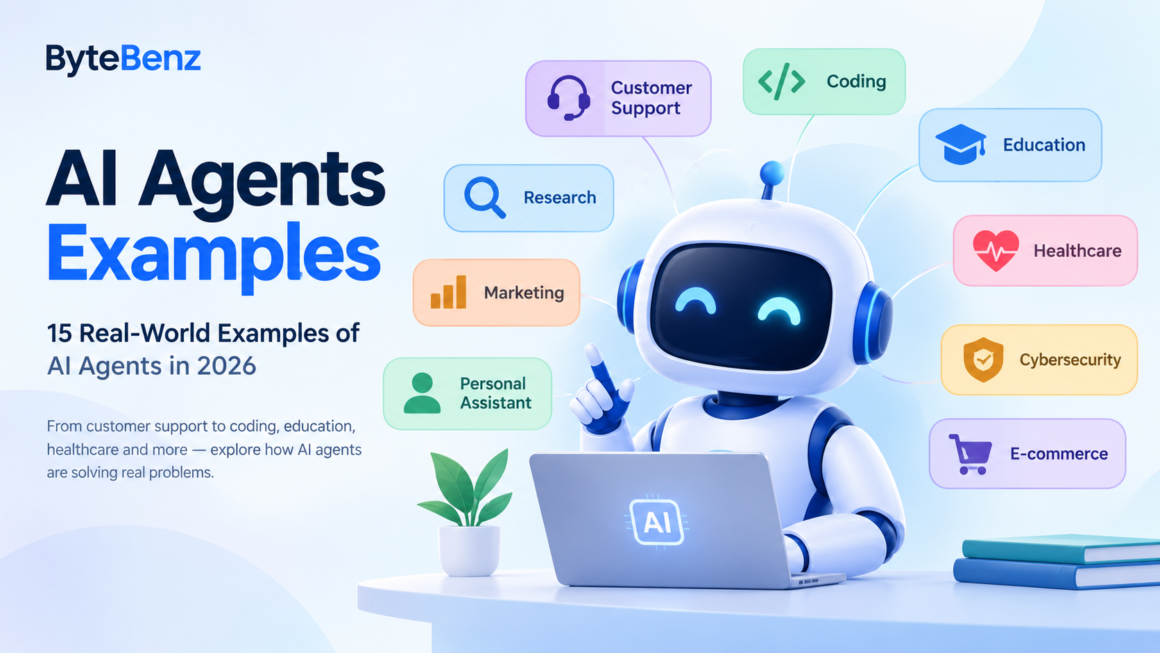
From customer support and software development to education, cybersecurity, marketing, and research, AI agents are being used for many different tasks. Some agents follow simple rules, while others can plan tasks, use external tools, learn from feedback, and adapt their actions.
In this guide, we will explore 15 AI agents examples, explain how AI agents work, look at the different types of agents in AI, and understand what a learning agent is with practical examples.
What Is an AI Agent?
An AI agent is a software system that can understand information from its environment, make decisions, and take actions to achieve a specific goal.
In simple words, an AI agent does more than just give you an answer. It can potentially decide what needs to be done and take the necessary steps to complete a task.
For example, imagine asking an AI system:
“Find three affordable hotels in Delhi for next weekend.”
A basic chatbot might provide general suggestions. An AI agent could potentially search available information, compare options, apply your preferences, and present a shortlist.
The exact capabilities depend on how the agent is designed and what tools it can access.
How Is an AI Agent Different From Normal Software?
Traditional software usually follows predefined instructions.
For example:
Input → Rule → Output
An AI agent can work with a more flexible process:
Goal → Understand → Plan → Act → Check Result → Continue
This makes AI agents useful for tasks where the system needs to handle multiple steps or changing information.
What Makes Something an AI Agent?
An AI agent commonly has several important components:
- Goal: What the system needs to achieve
- Input: Information it receives
- Reasoning: How it decides what to do
- Planning: How it breaks a task into steps
- Tools: External systems it can use
- Actions: What it does
- Feedback: Information used to evaluate results
- Memory: Information it may retain for future steps
Not every AI agent has all of these capabilities at the same level.
If you want to move from understanding AI agents to creating one, our guide on how to build AI agents explains the process in more detail.
How Do AI Agents Work?
The easiest way to understand an AI agent is to look at the process it follows.
Step 1: Understand the Goal
The user gives the AI agent an objective.
For example:
“Find the best way to travel from Delhi to Jaipur.”
The agent first needs to understand what “best” means. It could depend on price, travel time, comfort, or other preferences.
Step 2: Gather Information
The agent may collect information from available sources such as:
- Websites
- Databases
- APIs
- Documents
- Business systems
- Other software tools
The available information depends on the tools and permissions provided to the agent.
Step 3: Create a Plan
Instead of treating the request as one action, the agent can break it into smaller tasks.
For example:
- Find available travel options.
- Compare prices.
- Compare journey times.
- Check the user’s preferences.
- Shortlist suitable options.
Step 4: Take Action
An agent may then perform actions using connected tools.
These actions could include:
- Searching information
- Calling an API
- Creating a document
- Updating a CRM
- Writing or testing code
- Sending a message
- Generating a report
Step 5: Check the Result
The agent can evaluate what happened after an action.
If the result is not suitable, the system may adjust its approach and continue.
A simplified AI agent workflow looks like this:
Goal → Observe → Reason → Plan → Act → Feedback → Goal
If you want to understand how these systems can be created without traditional programming, check out our guide on build AI agents without coding.
What Are the Main Types of AI Agents?
AI agents have been studied in artificial intelligence for many years. Classical AI literature commonly describes different types based on how they make decisions and interact with their environment.
1. Simple Reflex Agents
Simple reflex agents respond to the current situation using predefined rules.
For example, a basic thermostat can follow a rule such as:
If temperature is below the set level → turn heating on.
The system does not necessarily need a complex model of the future.
2. Model-Based Reflex Agents
Model-based agents maintain some internal representation of the environment.
This allows them to make decisions using information beyond the immediate input.
A robot navigating an environment is a simple example of where an internal model can be useful.
3. Goal-Based Agents
Goal-based agents select actions based on a desired outcome.
For example, a navigation system has a destination as its goal and can evaluate possible routes to reach it.
4. Utility-Based Agents
Utility-based agents consider the quality or usefulness of different outcomes.
For example, a travel system might consider:
- Price
- Journey time
- Number of stops
- Convenience
It can then select an option based on the priorities defined for the task.
5. Learning Agents
A learning agent can improve its behaviour based on experience, feedback, or newly available information.
A recommendation system is a familiar example.
If a user repeatedly interacts with certain types of content, the system can use those signals to improve future recommendations.
15 AI Agents Examples in the Real World
AI agents can be found across many industries and workflows. Here are 15 practical examples.
1. AI Customer Support Agents
Customer support is one of the most common areas where AI agents can help businesses.
A customer support agent can potentially:
- Understand customer questions
- Retrieve relevant information
- Check order details
- Troubleshoot common problems
- Create support tickets
- Escalate complicated issues
Example
A customer asks:
“Where is my order?”
An AI support agent could identify the customer, access the relevant order information, check its status, and provide an update.
If the issue requires human intervention, the workflow can transfer the case to a support employee.
The important point is that the system is not only generating text. It can be connected to business systems and perform actions within defined permissions.
2. AI Coding Agents
AI coding agents are designed to assist with software development tasks.
Different AI coding tools take different approaches to software development. If you’re comparing popular coding-focused AI tools, see our detailed Claude Code vs Gemini CLI comparison.
Depending on the system and its permissions, a coding agent can:
- Understand a development request
- Inspect an existing codebase
- Write code
- Modify files
- Run tests
- Identify errors
- Suggest or implement fixes
- Explain changes
Example
A developer could ask:
“Add a login page and test the authentication flow.”
A coding agent may break the task into smaller steps, inspect the existing project, create relevant files, run tests, identify failures, and make changes.
Human review is still important, especially before deploying changes to production.
3. AI Research Agents
Research agents can help users collect and organise information.
They may be used to:
- Search multiple sources
- Collect relevant information
- Compare findings
- Summarise documents
- Organise research
- Prepare reports
Example
A business wants to research five competitors.
A research agent could be given a defined research task and gather information about their products, pricing, positioning, and other relevant factors.
The final information should still be checked against reliable sources because AI systems can make factual errors.
4. AI Personal Assistant Agents
AI assistants can help with everyday productivity tasks.
Possible tasks include:
- Managing schedules
- Creating reminders
- Summarising information
- Organising tasks
- Preparing messages
- Finding information
Example
Instead of asking only:
“What meetings do I have tomorrow?”
a more agentic system might be able to identify available calendar information and help organise the user’s schedule based on defined instructions.
The level of action an assistant can take depends on its integrations and permissions.
5. AI Sales Agents
Sales teams can use AI agents to automate parts of the lead management process.
Possible tasks include:
- Lead qualification
- Customer questions
- Follow-ups
- CRM updates
- Appointment scheduling
- Lead routing
Example
A person fills out a website form asking about a service.
An AI sales workflow could:
Receive lead → Ask qualifying questions → Analyse responses → Update CRM → Schedule meeting
This can reduce repetitive manual work while allowing sales teams to focus on higher-value conversations.
6. AI Marketing Agents
Marketing is another area where AI agents can assist with repetitive and research-heavy workflows.
Possible applications include:
- Keyword research
- Competitor research
- Content planning
- Campaign analysis
- Audience research
- Reporting
- Content optimisation
Example
A marketing workflow could use separate AI systems for:
Research → Content Planning → SEO Analysis → Drafting → Review
The important distinction is that an agentic workflow can connect multiple steps instead of treating every task as an isolated prompt.
7. AI Finance Agents
AI agents can assist with certain financial and administrative workflows.
Examples include:
- Transaction categorisation
- Report generation
- Financial information analysis
- Fraud or anomaly detection
- Customer support
- Document processing
Example
An organisation could use an AI system to review transactions and identify unusual patterns for further investigation.
However, financial applications require strong controls. An AI agent should not automatically make high-impact financial decisions without appropriate validation and oversight.
8. AI Healthcare Agents
Healthcare is another area where AI systems can support workflows.
Possible applications include:
- Appointment scheduling
- Patient communication
- Administrative support
- Documentation
- Information retrieval
- Medical research assistance
Example
A healthcare assistant could help a patient schedule an appointment based on available slots.
This is different from allowing an AI system to independently diagnose a medical condition or make treatment decisions.
For high-impact healthcare decisions, appropriate professional oversight is essential.
9. AI Education Agents
Education agents can provide personalised learning assistance.
They may help with:
- Tutoring
- Practice questions
- Study planning
- Explanations
- Learning recommendations
- Quiz generation
Example
Imagine a student struggling with algebra.
An AI learning system could:
- Identify areas where the student is struggling.
- Explain the concept.
- Generate practice questions.
- Review the student’s answers.
- Provide feedback.
- Adjust future practice.
This type of adaptive behaviour makes education a useful example of AI agents and learning systems.
10. AI Recommendation Agents
Recommendation systems are among the most familiar examples of intelligent systems.
They can recommend:
- Movies
- Music
- Products
- Videos
- Articles
- Courses
These systems can analyse signals such as user interactions, preferences, and historical behaviour.
Example
A user watches several videos about photography.
The recommendation system may identify patterns in that behaviour and suggest other photography-related content.
This is also a useful example of a learning agent in AI, because learning-based recommendation systems can use feedback and interaction data to improve recommendations.
11. Autonomous Driving Agents
Autonomous driving systems are complex examples of AI interacting with the physical world.
Such systems can involve:
- Environmental perception
- Object detection
- Path planning
- Decision-making
- Vehicle control
Example
An autonomous driving system may detect another vehicle, analyse the road situation, determine an appropriate path, and control vehicle actions according to the system’s capabilities.
Because these systems operate in safety-critical environments, reliability, testing, safeguards, and human oversight are extremely important.
12. AI Cybersecurity Agents
Cybersecurity teams can use AI systems to analyse large amounts of security information.
Potential applications include:
- Anomaly detection
- Threat analysis
- Alert prioritisation
- Security monitoring
- Incident investigation
- Response workflows
Example
An AI security workflow detects unusual login behaviour.
It can potentially:
Detect anomaly → Investigate related signals → Prioritise alert → Notify security team
This can help security professionals handle large numbers of alerts more efficiently.
13. AI Shopping Agents
AI shopping agents can help users research and compare products.
Possible tasks include:
- Finding products
- Comparing specifications
- Comparing prices
- Filtering options
- Creating shortlists
- Monitoring selected information
Example
A user could provide requirements such as:
“Find a laptop suitable for programming, with 16 GB RAM and a budget under ₹70,000.”
An agent could potentially gather matching products, compare specifications, and organise the results.
Users should still verify important specifications, prices, warranties, and availability before purchasing.
14. AI HR and Recruitment Agents
AI systems can assist with administrative recruitment workflows.
Possible uses include:
- Candidate communication
- Interview scheduling
- Job matching
- Resume organisation
- HR documentation
Example
After receiving applications, an AI system might help organise candidates according to predefined job requirements and assist with scheduling interviews.
However, employment decisions can have significant consequences. Human review and appropriate fairness controls are important when AI is used in recruitment.
15. Multi-Agent AI Systems
A multi-agent system uses multiple specialised agents or AI components that work together on a larger task.
For example, a content workflow might contain:
Research Agent → Writing Agent → SEO Agent → Review Agent
Each component has a different responsibility.
Example
Suppose a company wants to create a detailed market report.
One agent could collect information.
Another could analyse the data.
A third could prepare the report.
A fourth could review the final output.
This approach can divide a complex workflow into specialised tasks.
What Is an Example of a Learning Agent in AI?
A learning agent is an AI system that can improve its behaviour or performance using experience, feedback, or newly acquired information.
One simple example is a recommendation system.
Suppose a user regularly watches videos about digital marketing.
The system can observe signals such as:
- What the user watches
- What the user skips
- What the user searches for
- How long the user interacts with content
- Which recommendations receive engagement
These signals can be used by the underlying recommendation system to improve future recommendations.
How a Learning Agent Works
A simplified process looks like this:
User Interaction → Data/Feedback → Learning → Updated Behaviour → New Recommendation
The important point is that learning does not necessarily mean the AI model changes itself instantly after every interaction. Different systems use different learning, training, and feedback mechanisms.
Other Examples of Learning Agents
Learning-based AI systems can appear in areas such as:
- Recommendation systems
- Game-playing systems
- Adaptive education
- Fraud detection
- Robotics
- Personalisation systems
AI Agents vs Chatbots: What Is the Difference?
AI agents and chatbots can overlap, but they are not necessarily the same thing.
| Feature | Traditional Chatbot | AI Agent |
| Answers questions | Yes | Yes |
| Understands natural language | Often | Often |
| Performs external actions | Limited | Can |
| Uses tools | Limited | Can |
| Handles multi-step tasks | Usually limited | Can |
| Works toward a goal | Limited | Usually goal-oriented |
| Makes decisions | Limited | Can |
| Level of autonomy | Usually lower | Can vary |
A chatbot can simply respond to a user’s message.
An AI agent may be designed to plan and execute a series of actions to achieve a goal.
However, there is no single universal definition that makes every system clearly “a chatbot” or “an agent.” Modern AI products can contain both conversational and agentic components.
What Are AI Agents Used For?
AI agents can be used in many different areas.
Business
- Customer support
- Sales
- Marketing
- Operations
- Reporting
- Workflow automation
Personal Productivity
- Scheduling
- Research
- Task management
- Information retrieval
- Document assistance
Software Development
- Coding
- Debugging
- Testing
- Documentation
- Code review
Education
- Tutoring
- Personalised learning
- Practice generation
- Study planning
Cybersecurity
- Monitoring
- Detection
- Investigation
- Alert prioritisation
The specific benefits depend on the quality of the system, available data, tools, permissions, and human oversight.
What Are the Benefits of AI Agents?
AI agents can provide several practical benefits when they are designed for appropriate tasks.
Automating Repetitive Work
Agents can handle repetitive processes that otherwise require manual effort.
Handling Multi-Step Tasks
An agent can potentially coordinate several actions instead of requiring a person to manually execute every step.
Connecting Different Tools
AI agents can be integrated with APIs, databases, software applications, and business systems.
Personalisation
Learning-based systems can use relevant information and feedback to provide more personalised experiences.
Faster Information Processing
Agents can help process large amounts of information and organise it into useful outputs.
What Are the Limitations of AI Agents?
AI agents are powerful, but they are not perfect.
Inaccurate Information
AI systems can produce incorrect information or misunderstand instructions.
Hallucinations
Generative AI systems can sometimes produce information that sounds convincing but is not factual.
Security Risks
Giving an AI system access to external tools creates additional security considerations.
Privacy Concerns
Agents may work with sensitive information, so data handling and access controls are important.
Incorrect Actions
An autonomous system can potentially perform an unintended action if its instructions, tools, or safeguards are poorly designed.
Human Oversight
For high-impact tasks, human review can help catch errors and prevent harmful outcomes.
The goal is not simply to make an AI agent more autonomous. The goal is to give it the right level of autonomy for the task.
How to Choose the Right AI Agent for a Task
Before using an AI agent, consider these questions.
1. What Is the Goal?
Clearly define what you want the system to accomplish.
2. What Tools Does It Need?
Determine whether the agent needs access to:
- APIs
- Databases
- Websites
- CRM
- Documents
- Business software
3. How Much Autonomy Is Appropriate?
Some tasks should require human approval before an action is completed.
4. What Data Will It Access?
Identify whether the workflow contains personal, confidential, financial, or business-sensitive information.
5. How Will You Measure Results?
Define measurable outcomes such as:
- Accuracy
- Completion rate
- Response time
- Error rate
- Human intervention rate
This helps determine whether the agent is actually improving the workflow.
Key Takeaways About AI Agents
- AI agents are systems designed to work toward goals using information, reasoning, tools, and actions.
- AI agents can handle simple tasks as well as complex multi-step workflows.
- Common examples include customer support, coding, research, marketing, education, cybersecurity, and recommendation systems.
- A learning agent can use experience or feedback to improve its future behaviour.
- AI agents and chatbots are not necessarily the same.
- Modern agentic systems can connect AI models with external tools and software.
- The level of autonomy varies between different AI systems.
- Human oversight remains important for sensitive and high-impact tasks.
Frequently Asked Questions About AI Agents
What are some examples of AI agents?
Examples of AI agents include customer support agents, coding agents, research agents, sales agents, marketing agents, education agents, cybersecurity agents, shopping agents, recommendation systems, and personal assistant agents.
What is an example of a learning agent in AI?
A recommendation system is a common example of a learning agent in AI. It can use user interactions and feedback to improve future recommendations. Other examples include adaptive learning systems, game-playing AI, fraud detection systems, and some robotic systems.
Is ChatGPT an AI agent?
ChatGPT is primarily a conversational AI system, but AI models such as those used in ChatGPT can also be incorporated into agentic systems that use tools and perform multi-step tasks. Whether a particular implementation is an “AI agent” depends on its architecture, tools, and level of autonomy.
What is the difference between an AI agent and a chatbot?
A chatbot primarily focuses on conversational interaction, while an AI agent can be designed to pursue a goal, use tools, make decisions, and perform multiple actions. Some modern AI systems combine chatbot and agentic capabilities.
What are AI agents used for?
AI agents can be used for customer support, software development, research, sales, marketing, education, cybersecurity, personal productivity, recommendations, and business workflow automation.
What are autonomous AI agents?
Autonomous AI agents are systems designed to perform tasks with limited human intervention. Their autonomy can vary. Some may only perform a few predefined actions, while others can plan and execute longer workflows.
What are examples of intelligent agents in AI?
Examples include simple reflex agents, model-based agents, goal-based agents, utility-based agents, and learning agents. Modern AI agents can combine ideas from these traditional categories with machine learning and generative AI.
Can AI agents learn from experience?
Some AI systems can use experience, feedback, or historical data to improve their behaviour. However, not every AI agent automatically learns from every interaction. Learning depends on how the system is designed and trained.
Are AI agents the same as generative AI?
No. Generative AI refers to AI systems that can generate content such as text, images, audio, or code. An AI agent is a system designed to pursue goals and take actions. Generative AI models can be used as components inside AI agents.
What are the advantages of AI agents?
AI agents can automate repetitive work, handle multi-step workflows, connect different tools, process information, and provide personalised assistance. Their effectiveness depends on the task, system design, data, and safeguards.
What are the risks of AI agents?
Potential risks include inaccurate outputs, hallucinations, privacy issues, security problems, biased results, and unintended actions. The risks increase when an AI system has access to sensitive data or permission to perform important actions without human review.
Conclusion
AI agents represent an important development in artificial intelligence because they can go beyond generating answers and help complete tasks through planning, tool use, decision-making, and actions.
The AI agents examples discussed in this guide show how the technology can be applied across customer service, coding, research, marketing, education, finance, cybersecurity, shopping, and many other areas.
A learning agent is another important concept. Recommendation systems and adaptive learning systems show how AI can use experience or feedback to improve future behaviour.
However, AI agents are not automatically fully autonomous or always reliable. Their capabilities depend on their architecture, tools, data, permissions, and safeguards.
As agentic AI continues to develop, understanding how AI agents work, where they are useful, and where human oversight is needed will become increasingly important for businesses, developers, students, and everyday users.
Want to learn more about AI and technology? Explore more practical AI guides on ByteBenz.