
Artificial intelligence is no longer limited to experimental projects or consumer-facing tools. Businesses across industries are using AI to automate workflows, analyze data, improve customer experiences, support employees, and build new digital products.
But there is a difference between subscribing to a general-purpose AI tool and building an AI solution specifically for your business.
A generic AI application may answer questions, generate content, or summarize information. A custom AI solution can go much further: it can connect to your business systems, work with proprietary data, follow specific workflows, use business rules, and perform tasks designed around your organization’s goals.
That is where custom AI development comes in.
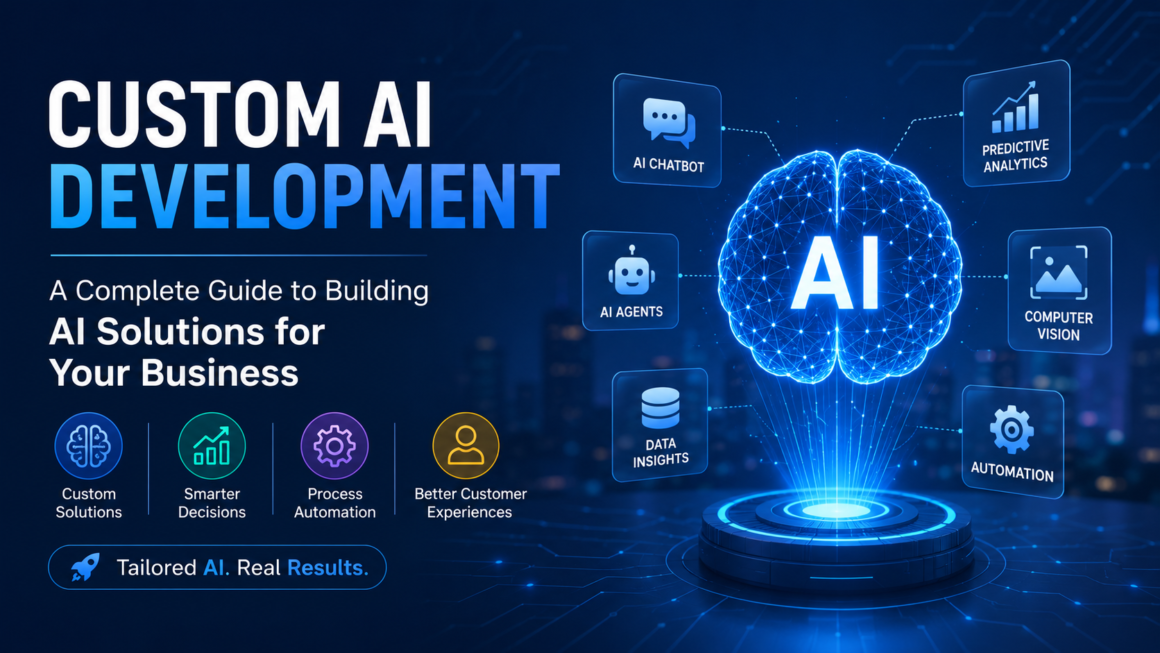
Custom AI development is the process of designing, developing, integrating, and deploying AI-powered software around a company’s specific business requirements. Depending on the use case, this could involve an AI chatbot, AI agent, recommendation engine, predictive model, document-processing system, AI-powered application, or an intelligent automation workflow.
However, custom AI does not always mean building an AI model from scratch. In many cases, businesses can create powerful custom AI software using existing foundation models, APIs, retrieval-augmented generation (RAG), fine-tuning, traditional machine learning, or a combination of these technologies.
This guide explains how custom AI development works, what businesses can build, how much it can cost, which technologies are involved, and how to decide whether a custom AI solution is right for your organization.
Key Takeaways
- Custom AI development creates AI-powered software around specific business requirements.
- A custom AI application does not necessarily require training a model from scratch.
- Businesses can combine foundation models, APIs, RAG, machine learning, AI agents, and proprietary data.
- The right architecture depends on the business problem, data, security requirements, integrations, and expected scale.
- A successful AI project should begin with a measurable business problem rather than a technology-first approach.
- MVP development can help businesses validate an AI use case before making a larger investment.
- Data quality, evaluation, security, monitoring, and ongoing maintenance are critical to long-term AI performance.
- Businesses should compare building, buying, and integrating AI before choosing a development strategy.
What Is Custom AI Development?
Custom AI development is the process of building AI-powered software specifically around a business’s unique data, workflows, users, integrations, and objectives.
Unlike a general-purpose AI tool, a custom solution can be designed to solve a particular business problem and operate within an organization’s existing technology environment.
For example, an e-commerce company could build a custom AI assistant that understands its product catalog, inventory information, return policies, and customer history. Instead of simply generating generic answers, the system could retrieve current information from business databases and help customers complete specific tasks.
A professional services company might build an AI document-processing application that extracts information from contracts, organizes documents, identifies relevant clauses, and sends structured information into an internal system.
A software company could integrate an AI agent into its product that researches information, uses external tools, performs multi-step actions, and provides users with an intelligent workflow.
The common element is customization around a specific business requirement.
Custom AI Development Explained in Simple Terms
Think of a general AI tool as a capable employee who has broad knowledge but does not know your company’s internal processes.
Custom AI development gives that employee access to the right:
- Business information
- Software systems
- Data sources
- Workflows
- Tools
- Business rules
- Permissions
- User interfaces
The goal is not simply to make AI more powerful. The goal is to make AI more useful for a specific business context.
How Is Custom AI Different From Off-the-Shelf AI?
Off-the-shelf AI products are designed to serve many customers with common requirements. Custom AI is designed around the requirements of a particular organization.
| Factor | Off-the-Shelf AI | Custom AI |
| Primary purpose | General use cases | Specific business requirements |
| Customization | Limited to available features | High |
| Business data | Usually limited | Can connect to proprietary data |
| Integrations | Prebuilt integrations | Custom integrations possible |
| Workflows | Standardized | Business-specific |
| User experience | Vendor-defined | Can be designed around users |
| Control | Limited | Greater control |
| Scalability | Depends on provider | Architecture can be designed around requirements |
| Development effort | Low | Higher |
| Flexibility | Moderate to low | High |
Off-the-shelf tools can be the right choice when your requirements are common. Custom development becomes more attractive when existing tools cannot adequately support the workflow, data, integration, or experience you need.
Why Are Businesses Investing in Custom AI Development?
Businesses are moving beyond simply experimenting with AI.
The bigger opportunity is integrating AI into real operational processes.
A company might already use an AI writing assistant or chatbot. The next question is often:
How can AI work with our actual business data and systems?
That shift creates opportunities for custom AI development.
Automate Complex Business Workflows
Many business processes involve repetitive decisions, information retrieval, classification, document handling, or communication.
Custom AI can help automate parts of these workflows.
For example, an AI system could:
- Receive a customer request.
- Identify the customer’s intent.
- Retrieve relevant account information.
- Check business rules.
- Generate an appropriate response.
- Update a CRM record.
- Escalate the request if human intervention is required.
This is more sophisticated than simply adding a chatbot to a website.
Work With Proprietary Business Data
A company’s internal information can be one of its most valuable AI resources.
This could include:
- Product documentation
- Knowledge bases
- Customer records
- Internal policies
- Contracts
- Support tickets
- Technical documentation
- Sales information
- Historical business data
Custom AI systems can be designed to retrieve and use relevant information while applying appropriate access controls.
Improve Customer Experiences
Customers increasingly expect fast and relevant digital experiences.
Custom AI can support:
- Personalized recommendations
- Intelligent search
- Automated support
- Product discovery
- Conversational commerce
- Personalized onboarding
- 24/7 assistance
The advantage comes from connecting AI to the information and workflows that actually matter to the customer.
Reduce Manual Work
AI can assist employees with tasks such as:
- Summarizing information
- Extracting data from documents
- Categorizing requests
- Drafting responses
- Researching information
- Generating reports
- Updating records
- Processing repetitive requests
The objective should not always be to eliminate human involvement. Often, the better approach is to let AI handle repetitive work while employees focus on higher-value decisions.
Build AI Around Existing Software
Businesses rarely operate from a single system.
They may use:
- CRM platforms
- ERP systems
- Accounting software
- Customer support platforms
- Databases
- Marketing platforms
- Internal applications
- Cloud services
Custom AI software can be designed to communicate with these systems through APIs and other integrations.
Create Competitive Differentiation
Using the same general-purpose AI tools as competitors does not necessarily create a long-term advantage.
A custom AI workflow built around proprietary data, specialized processes, and a unique customer experience can be harder to replicate.
That does not mean every company needs custom AI. It means businesses should identify where AI can create value that generic tools cannot easily provide.
What Types of Custom AI Solutions Can Businesses Build?
Custom AI is not one type of product. It is a broad category that can include multiple technologies and applications.
Custom AI Chatbots
A custom AI chatbot can be designed for a specific organization, product, or workflow.
Possible applications include:
- Customer support
- Sales assistance
- Product recommendations
- Employee help desks
- Knowledge management
- Website assistance
- Technical support
- Lead qualification
A basic chatbot may answer predefined questions. A more advanced custom AI chatbot can retrieve information, connect to business systems, maintain context, and perform selected actions.
For example, a customer support chatbot could retrieve an order’s current status instead of simply telling the customer to contact support.
Custom AI Agents
AI agents are designed to perform tasks rather than simply generate responses.
Depending on their architecture and permissions, an AI agent may:
- Interpret a user’s goal
- Break a task into steps
- Retrieve information
- Call APIs
- Use software tools
- Make decisions based on defined rules
- Complete actions
- Report the result
For example, a sales AI agent might research a prospect, summarize relevant information, update a CRM, and prepare a personalized follow-up for review.
Because agents can interact with tools and systems, they require careful design around permissions, reliability, security, and human oversight.
Custom AI Models
Some businesses need models that are optimized for particular tasks.
Examples include:
- Classification models
- Prediction models
- Recommendation models
- Computer vision models
- Domain-specific language models
- Forecasting models
However, building a model from scratch is often unnecessary.
A business should first determine whether an existing model, API, RAG architecture, fine-tuning approach, or traditional machine learning model can solve the problem more efficiently.
AI-Powered Business Automation
AI can be incorporated into business automation workflows.
Examples include:
- Invoice processing
- Document classification
- Lead qualification
- Email categorization
- Customer request routing
- Report generation
- Data extraction
- Internal knowledge retrieval
AI is particularly useful when workflows involve unstructured information such as text, documents, or natural-language requests.
AI Recommendation Engines
Recommendation systems can analyze user behavior, preferences, product information, or historical interactions to suggest relevant products, content, or services.
Examples include:
- E-commerce recommendations
- Content recommendations
- Product discovery
- Personalized learning
- Media recommendations
Predictive Analytics Solutions
Machine learning can identify patterns in historical data and help businesses estimate future outcomes.
Potential applications include:
- Demand forecasting
- Customer churn analysis
- Fraud detection
- Risk assessment
- Sales forecasting
- Predictive maintenance
The quality of predictions depends heavily on the quality, relevance, and representativeness of the underlying data.
Computer Vision Applications
Custom AI can also process images and video.
Potential use cases include:
- Quality inspection
- Object detection
- Document processing
- Visual search
- Image classification
- Safety monitoring
The appropriate approach depends on the visual task, environment, data, accuracy requirements, and operational constraints.
Custom AI Software Development vs. Custom AI Model Development
These terms are often used interchangeably, but they describe different things.
What Is Custom AI Software Development?
Custom AI software development focuses on creating an application or system that uses AI to solve a particular business problem.
The application may use an existing AI model through an API rather than creating a new model.
For example, a business could build:
- An AI customer support platform
- An internal AI assistant
- An AI-powered document application
- An AI sales assistant
- An AI research tool
The software, integrations, workflow, user interface, and business logic can all be custom-built.
What Is Custom AI Model Development?
Custom AI model development focuses more specifically on creating, training, adapting, or fine-tuning a machine learning or AI model for a particular requirement.
This may involve:
- Dataset preparation
- Model selection
- Training
- Fine-tuning
- Evaluation
- Optimization
- Deployment
- Monitoring
A custom model can be useful when existing models do not meet the required performance, behavior, cost, latency, or domain requirements.
Do You Actually Need a Custom AI Model?
Not necessarily.
This is one of the most important decisions in an AI project.
Many custom AI applications can be built using existing foundation models combined with business data, RAG, APIs, application logic, and integrations.
A custom model may make sense when you have:
- Highly specialized requirements
- Large and valuable proprietary datasets
- Consistent domain-specific patterns
- Specialized prediction requirements
- Strict latency requirements
- Specific cost considerations at scale
- Performance requirements that existing models cannot meet
The correct question is not:
“Should we build our own AI model?”
It is:
“What is the simplest AI architecture that can reliably solve our business problem?”
How Does Custom AI Development Work?
A successful custom AI project typically follows a structured development process.
Step 1: Define the Business Problem
Start with the problem, not the technology.
For example:
Weak objective:
“We want an AI chatbot.”
Better objective:
“We want to reduce repetitive customer support requests by automatically resolving common product and order questions.”
The second objective provides a measurable business outcome.
Step 2: Identify AI Use Cases
Not every process needs AI.
Evaluate potential use cases based on:
- Business value
- Feasibility
- Data availability
- Complexity
- Risk
- Expected ROI
- User impact
Prioritize use cases where AI can create measurable improvement.
Step 3: Audit and Prepare Your Data
Data is central to many AI applications.
Review:
- Where the data comes from
- How accurate it is
- How current it is
- Who can access it
- Whether it contains sensitive information
- How it is structured
- Whether it needs labeling or cleaning
Poor-quality data can create poor AI outcomes regardless of how sophisticated the model is.
Step 4: Choose the Right AI Approach
Possible approaches include:
- Existing AI APIs
- Foundation models
- Retrieval-augmented generation
- Fine-tuning
- Traditional machine learning
- Custom models
- AI agents
- Hybrid architectures
For example, a company that wants AI to answer questions about internal documents may benefit from RAG rather than training a model from scratch.
Step 5: Design the AI Architecture
The architecture determines how the different components work together.
A typical system may include:
Users → Application → AI Layer → Data/Knowledge Layer → Business Systems
Additional components may include:
- Authentication
- Authorization
- APIs
- Databases
- Vector databases
- Monitoring
- Logging
- Evaluation systems
- Security controls
Architecture should be designed around the requirements rather than around whichever AI technology is currently trending.
Step 6: Develop an MVP
A minimum viable product can help validate the idea before a full-scale implementation.
An MVP should focus on the core workflow.
For example, instead of building a complete AI support platform immediately, a business might first create an internal prototype that answers questions using a limited knowledge base.
The team can then measure:
- Accuracy
- User satisfaction
- Response time
- Failure cases
- Business impact
Step 7: Test and Evaluate the AI
AI applications require more than traditional software testing.
Evaluation may include:
- Accuracy
- Relevance
- Hallucination rate
- Consistency
- Latency
- Security
- Reliability
- Cost per request
- User experience
Create representative test cases before deployment.
Step 8: Integrate With Existing Systems
An AI system becomes significantly more useful when it can work with existing business applications.
Possible integrations include:
- CRM
- ERP
- Help desk
- Databases
- Payment systems
- Inventory systems
- Marketing platforms
- Internal APIs
Integration requirements should be considered early rather than treated as an afterthought.
Step 9: Deploy the AI Solution
Deployment may involve:
- Cloud infrastructure
- APIs
- Containers
- Databases
- Authentication
- Monitoring
- Logging
- Security controls
The deployment environment should reflect expected traffic, data sensitivity, availability requirements, and scalability needs.
Step 10: Monitor, Improve, and Scale
AI development does not necessarily end when the software launches.
Real-world usage can reveal:
- Unexpected questions
- Data gaps
- Incorrect outputs
- New use cases
- Performance problems
- Cost issues
Continuous evaluation and improvement help maintain system quality over time.
What Technologies Are Used in Custom AI Development?
The technology stack depends on the application.
Large Language Models
Large language models can power:
- Conversational interfaces
- Content generation
- Summarization
- Research assistants
- Coding assistants
- Document analysis
- AI agents
Businesses can often access these models through APIs rather than managing model infrastructure themselves.
Machine Learning
Traditional machine learning remains useful for structured prediction and classification problems.
Examples include:
- Forecasting
- Risk scoring
- Classification
- Recommendation
- Anomaly detection
Natural Language Processing
NLP technologies help software understand and process human language.
Applications include:
- Text classification
- Sentiment analysis
- Entity extraction
- Search
- Document analysis
Generative AI
Generative AI can produce:
- Text
- Images
- Code
- Audio
- Other forms of content
Custom applications can incorporate generative AI into workflows while adding business-specific data, rules, and controls.
Retrieval-Augmented Generation
RAG allows an AI application to retrieve relevant information from a knowledge source before generating a response.
A simplified workflow looks like this:
User Question → Search Relevant Information → Provide Context to Model → Generate Answer
RAG can be useful when an organization wants an AI system to work with frequently changing or proprietary information without necessarily retraining the underlying model.
AI Agents and Tool Calling
AI agents can interact with external tools and systems.
For example:
User Request → Agent → Retrieve Data → Call API → Perform Task → Return Result
This architecture can enable more sophisticated automation but also introduces additional security and reliability considerations.
Vector Databases and Embeddings
Embeddings represent information in a mathematical format that makes semantic search possible.
Vector databases can store these representations and help applications retrieve information based on meaning rather than exact keyword matches.
They are commonly used in RAG systems and AI-powered search.
Cloud AI Infrastructure
Cloud platforms can provide infrastructure for:
- Model hosting
- Data storage
- APIs
- Databases
- Machine learning workloads
- Monitoring
- Security
The right infrastructure depends on the project’s scale and requirements.
How Much Does Custom AI Development Cost?
There is no single price for custom AI development.
A simple AI-powered application using an existing model and a small number of integrations can be significantly less complex than an enterprise AI platform involving custom models, large datasets, advanced security, multiple integrations, and high-volume infrastructure.
The cost should therefore be estimated based on the project rather than a generic industry number.
Factors That Affect Custom AI Development Cost
Major cost factors include:
- AI architecture
- Application complexity
- Data preparation
- Model requirements
- Number of integrations
- User interface requirements
- Security requirements
- Infrastructure
- Testing and evaluation
- Development team
- Expected usage
- Ongoing maintenance
MVP vs. Full-Scale AI Product
An MVP generally focuses on proving whether the core use case works.
A production-ready product may require:
- Advanced authentication
- Role-based access
- Scalable infrastructure
- Monitoring
- Analytics
- Extensive testing
- Error handling
- Security controls
- Multiple integrations
- Administrative tools
Building an MVP first can reduce the risk of investing heavily in an unvalidated idea.
Development vs. Ongoing AI Costs
Development is only one part of the total cost.
Depending on the architecture, ongoing costs may include:
- Model API usage
- Cloud infrastructure
- Storage
- Database services
- Vector database usage
- Monitoring
- Maintenance
- Data processing
- Security
- Model evaluation
Businesses should estimate both initial development costs and recurring operational costs.
How to Estimate Your AI Development Budget
A practical approach is to break the project into:
- Discovery
- Data preparation
- Architecture
- MVP development
- Testing
- Integrations
- Production deployment
- Monitoring
- Maintenance
This produces a more realistic estimate than choosing a price based solely on the type of AI.
What Are the Benefits of Custom AI Development?
Better Business-Specific Performance
A custom solution can be designed around the information and workflow your business actually uses.
Greater Flexibility
You can determine how the application behaves, what systems it connects to, and which users can access specific functionality.
Improved Workflow Automation
Custom AI can automate processes that generic tools cannot easily understand.
Better Use of Proprietary Data
Businesses can build applications around internal knowledge and data while implementing appropriate access controls.
Scalability
The architecture can be designed around expected business growth and usage.
Integration With Existing Systems
AI can become part of an existing workflow rather than another disconnected application.
Greater Control Over Security and Governance
Custom applications provide opportunities to design authentication, authorization, data handling, logging, and monitoring around organizational requirements.
Long-Term Differentiation
A well-designed AI workflow can become part of a company’s product, operations, or customer experience.
What Are the Challenges of Custom AI Development?
Custom AI can create significant value, but it is not without challenges.
High Initial Investment
Custom software requires planning, development, testing, and deployment.
Data Quality Problems
Incomplete, outdated, inconsistent, or poorly structured data can reduce AI performance.
AI Hallucinations
Generative AI systems can sometimes produce information that is inaccurate or unsupported.
Applications should use appropriate grounding, validation, evaluation, and human oversight for higher-risk use cases.
Security and Privacy Risks
AI systems can process sensitive business information.
Organizations should carefully evaluate:
- Data access
- Authentication
- Authorization
- Data storage
- API security
- Prompt injection risks
- Third-party services
- Logging
- Retention policies
Integration Complexity
Connecting AI to existing systems can sometimes require more work than building the AI interface itself.
Model Maintenance
AI applications may require ongoing monitoring as:
- Data changes
- Business requirements evolve
- Models change
- APIs change
- User behavior changes
Unclear ROI
Not every AI project produces enough business value to justify its cost.
That’s why use-case selection and measurable KPIs should come before development.
Custom AI Development Use Cases by Industry
Custom AI can be adapted to many industries, but the actual implementation should reflect the organization’s processes and regulatory environment.
Healthcare
Potential applications include:
- Administrative automation
- Document processing
- Patient communication support
- Knowledge retrieval
Healthcare implementations require careful consideration of privacy, security, accuracy, and applicable regulations.
Financial Services
Potential applications include:
- Document analysis
- Customer support
- Fraud detection
- Risk analysis
- Workflow automation
Financial applications often require strong governance and validation because inaccurate outputs can have significant consequences.
Retail and E-commerce
Retail businesses can use AI for:
- Product recommendations
- Personalized search
- Customer support
- Demand forecasting
- Product discovery
- Customer segmentation
SaaS and Technology
Technology companies can develop:
- AI copilots
- Developer assistants
- Automated support
- Product intelligence
- AI-powered search
- Documentation assistants
Manufacturing
Potential use cases include:
- Predictive maintenance
- Quality inspection
- Demand forecasting
- Process optimization
- Visual inspection
Professional Services
AI can support:
- Research
- Document analysis
- Knowledge management
- Report generation
- Workflow automation
Real Estate
Potential applications include:
- Lead qualification
- Property search
- Customer communication
- Document processing
- Property data analysis
The most valuable use case is usually the one that solves a specific operational problem rather than the one that simply demonstrates impressive AI capabilities.
How to Choose a Custom AI Development Company
Choosing a development partner is an important part of the project.
A company may have excellent software development skills but limited AI experience, or strong AI expertise but weak experience with production software and integrations.
Look for both.
Evaluate Technical Expertise
Ask how the development team approaches:
- AI architecture
- Model selection
- RAG
- AI agents
- Data engineering
- Integrations
- Evaluation
- Security
- Deployment
Ask About Previous AI Projects
Look for relevant examples rather than generic claims.
The most useful case studies explain:
- The business problem
- The approach
- The technology
- The implementation
- The measurable outcome
Check Their Approach to Data Security
Ask:
- Where will data be processed?
- How will access be controlled?
- How is sensitive information handled?
- What third-party AI services are involved?
- How is data stored?
- What monitoring is available?
Understand Their AI Development Process
A strong partner should be able to explain how they move from:
Discovery → Architecture → MVP → Testing → Deployment → Monitoring
Ask How They Measure AI Performance
A serious AI project needs measurable evaluation.
Ask what metrics will be used and how failures will be identified.
Evaluate Integration Capabilities
If your AI needs to work with a CRM, ERP, database, or internal software, verify that the development team understands API and system integration.
Discuss Post-Launch Support
AI applications may require ongoing:
- Monitoring
- Maintenance
- Optimization
- Security updates
- Model evaluation
- Feature development
Don’t Choose a Vendor Based Only on Price
The cheapest initial quote may not be the cheapest overall solution.
A better comparison considers:
- Technical approach
- Architecture
- Security
- Development quality
- Support
- Scalability
- Total cost of ownership
Questions to Ask Before Hiring an AI Development Partner
Before signing a project agreement, ask:
- What AI architecture would you recommend for our use case?
- Do we actually need a custom AI model?
- Could an existing model or API solve the problem?
- How will our data be protected?
- How will AI accuracy be evaluated?
- What integrations are possible?
- What will the MVP include?
- How will ongoing AI costs be managed?
- How will the system be monitored after launch?
- What happens when the AI produces an incorrect response?
The quality of the answers can tell you a lot about the development partner.
Custom AI Development for Small Businesses vs. Enterprises
The right AI strategy depends partly on organizational scale.
Custom AI for Small Businesses
Small businesses can benefit from focusing on narrow, high-value use cases.
Examples include:
- Customer support automation
- Lead qualification
- Document processing
- Internal knowledge assistants
- Marketing automation
- Scheduling workflows
A focused MVP can often make more sense than attempting to build a large AI platform.
Custom AI for Enterprises
Enterprise projects often require additional considerations:
- Security
- Governance
- Data architecture
- Role-based access
- Multiple integrations
- Scalability
- Compliance
- Monitoring
- Department-level workflows
Enterprise AI may also involve multiple AI applications operating within a shared architecture.
Which Approach Is Right for Your Business?
A useful starting point is to ask:
- What business problem are we solving?
- How frequently does it occur?
- How much does it currently cost?
- What data is available?
- What systems must the AI access?
- What happens if the AI is wrong?
- How will success be measured?
These questions are more useful than simply asking whether the business “needs AI.”
Custom AI Development: Build vs. Buy vs. Integrate
Businesses don’t always need to build everything themselves.
There are three broad options.
| Approach | Best For | Customization | Complexity |
| Buy | Common requirements | Low | Low |
| Integrate | Existing AI capabilities | Medium | Medium |
| Build | Unique requirements | High | High |
When Should You Buy an AI Tool?
Buy when:
- The problem is common.
- A mature product already exists.
- Customization requirements are limited.
- Speed is more important than differentiation.
- The software meets your security and integration requirements.
When Should You Integrate Existing AI?
Integration can be a strong middle ground.
For example, a business might use an existing AI model but build its own application, data retrieval layer, business logic, and integrations.
This can provide substantial customization without requiring the company to create a foundation model.
When Should You Build Custom AI?
Building makes more sense when:
- Existing products cannot solve the problem.
- The workflow is highly specialized.
- Proprietary data creates unique value.
- Deep integrations are required.
- The AI experience is part of the product itself.
- The business needs significant control over functionality.
The best solution is often a combination rather than a choice between 100% build and 100% buy.
How to Start a Custom AI Development Project
You don’t need to start by choosing a model.
Start with the business case.
Define One High-Value Use Case
Choose a problem that is:
- Specific
- Repetitive
- Measurable
- Technically feasible
- Valuable enough to justify development
Set Measurable KPIs
Possible KPIs include:
- Time saved
- Cost reduction
- Response time
- Customer satisfaction
- Conversion rate
- Resolution rate
- Accuracy
- Employee productivity
For example, instead of saying:
“We want to improve customer support with AI.”
Define:
“We want to automatically resolve a defined percentage of repetitive support requests while maintaining an acceptable accuracy and escalation rate.”
The second goal can be measured.
Assess Your Data
Identify:
- Data sources
- Data quality
- Data ownership
- Access requirements
- Sensitive information
- Update frequency
Choose the Right Development Approach
Determine whether your project needs:
- An AI API
- RAG
- Fine-tuning
- Machine learning
- An AI agent
- A custom model
- A hybrid architecture
Build an MVP
Keep the first version focused.
The purpose of an MVP is to answer:
Does this AI solution actually create enough value to justify scaling it?
Measure Results Before Scaling
Use real-world data to evaluate the solution.
If the MVP performs well, expand its capabilities, integrations, and user base.
Common Mistakes Businesses Make With Custom AI Development
Starting With Technology Instead of the Problem
Choosing an AI model before defining the business problem can lead to unnecessary complexity.
Building a Custom Model When an Existing Model Would Work
Training a model from scratch can be expensive and unnecessary.
Always evaluate simpler approaches first.
Ignoring Data Quality
A sophisticated AI architecture cannot compensate for fundamentally poor data.
Skipping AI Evaluation
A demo that works on five examples is not necessarily production-ready.
Test realistic scenarios, including edge cases and failure conditions.
Underestimating Integration Work
Connecting AI to existing systems may require substantial engineering.
Plan integrations early.
Ignoring Security and Privacy
AI systems can introduce new data and application security risks.
Security should be considered during architecture and development rather than added after launch.
Trying to Automate Everything at Once
A large AI transformation can become difficult to manage.
Start with one high-value workflow and expand based on results.
Not Defining Success Metrics
Without measurable outcomes, it becomes difficult to determine whether the project is working.
What Does the Future of Custom AI Development Look Like?
AI development is moving toward increasingly integrated systems.
Businesses are not only using AI to generate text or answer questions. They are building applications where AI can retrieve information, reason through workflows, use tools, and assist with business operations.
AI agents are one part of this shift.
Another is the combination of AI with existing business software. Instead of having employees move between multiple applications, AI can increasingly act as an intelligent interface across systems.
At the same time, businesses will need stronger approaches to:
- AI evaluation
- Security
- Governance
- Data management
- Human oversight
- Model selection
- Cost management
The future of custom AI is therefore not simply about using larger models. It is about building reliable systems that solve measurable business problems.
Key Takeaways
Custom AI development can help businesses create AI solutions that fit their specific data, workflows, systems, and objectives.
The most important lessons are:
- Start with the business problem, not the AI technology.
- Custom AI software does not always require a custom AI model.
- Existing foundation models can power highly customized applications.
- RAG can connect AI applications to proprietary knowledge.
- AI agents can support more complex, multi-step workflows.
- Data quality directly affects AI performance.
- Security and governance should be considered from the beginning.
- MVP development can reduce the risk of large upfront investments.
- AI systems need ongoing evaluation and monitoring.
- Build, buy, and integrate are all valid strategies depending on the use case.
The goal of custom AI development isn’t to add AI simply because it is available. The goal is to create a system that produces measurable business value.
Frequently Asked Questions About Custom AI Development
What is custom AI development?
Custom AI development is the process of creating AI-powered software around a business’s specific requirements, data, workflows, users, and systems. It can involve existing AI models, APIs, RAG, machine learning, fine-tuning, AI agents, or custom models depending on the use case.
How does custom AI development work?
Custom AI development typically starts by identifying a business problem and defining measurable goals. The development team then evaluates data, chooses an appropriate AI architecture, develops an MVP, tests the system, integrates it with existing software, deploys it, and continuously monitors and improves performance.
How much does custom AI development cost?
Custom AI development costs vary significantly based on application complexity, AI architecture, data preparation, integrations, security requirements, infrastructure, and ongoing maintenance. A focused AI application can require substantially less investment than an enterprise platform involving custom models, multiple integrations, and large-scale infrastructure.
How long does it take to build a custom AI solution?
Development time depends on the scope and complexity of the project. A focused MVP can be developed faster than a production-scale AI platform with multiple integrations, extensive security requirements, custom models, and large datasets. Defining a narrow initial use case can help reduce development time.
What is the difference between custom AI and generative AI?
Generative AI refers to AI systems capable of creating content such as text, images, code, or other outputs. Custom AI refers to AI software designed around specific business requirements. A custom AI application can use generative AI as one component of its architecture.
Do I need a custom AI model for my business?
Not necessarily. Many businesses can build effective custom AI solutions using existing foundation models, APIs, RAG, business logic, and integrations. A custom model may be appropriate when specialized requirements cannot be adequately addressed by existing models or simpler approaches.
What is custom AI software development?
Custom AI software development involves building an application that uses AI to solve a specific business problem. The application, user experience, workflows, integrations, data retrieval, business logic, and other components can be customized around the organization’s requirements.
What are custom AI agents?
Custom AI agents are AI-powered systems designed to perform tasks using defined tools, data sources, and workflows. Depending on their design, an agent can retrieve information, call APIs, complete multiple steps, and interact with business software while operating within defined permissions.
What businesses benefit from custom AI development?
Businesses with repetitive workflows, proprietary data, complex processes, customer-service demands, or specialized software requirements may benefit from custom AI. Common applications include customer support, document processing, forecasting, recommendations, internal knowledge systems, workflow automation, and AI-powered products.
How do I choose a custom AI development company?
Look for a development company with experience in AI architecture, software development, data engineering, integrations, security, testing, deployment, and ongoing support. Ask about relevant projects, development methodology, AI evaluation, data security, infrastructure, and post-launch maintenance before making a decision.
Can custom AI integrate with existing business software?
Yes. Custom AI applications can often integrate with CRMs, ERPs, databases, help desks, internal applications, and other business systems through APIs or other integration methods. The feasibility and complexity depend on the systems involved and the permissions and data they expose.
Is custom AI development secure?
Custom AI can be designed with security controls such as authentication, authorization, data access restrictions, encryption, monitoring, and logging. However, security depends on the architecture, implementation, AI providers, data practices, and operational controls. Security requirements should be addressed throughout development rather than treated as a final step.
Ready to Explore Custom AI for Your Business?
The best custom AI project starts with a clearly defined problem—not with a decision to use the latest AI model.
Before investing in development, identify the workflow you want to improve, the data available to support it, the systems that need to be connected, and the business outcome you want to achieve.
From there, you can determine whether an existing AI tool, an integrated AI solution, or fully custom AI software makes the most sense.
If your business has a specific AI use case in mind, ByteBenz can help you evaluate the requirements, identify the right development approach, and turn the concept into a practical AI solution.