


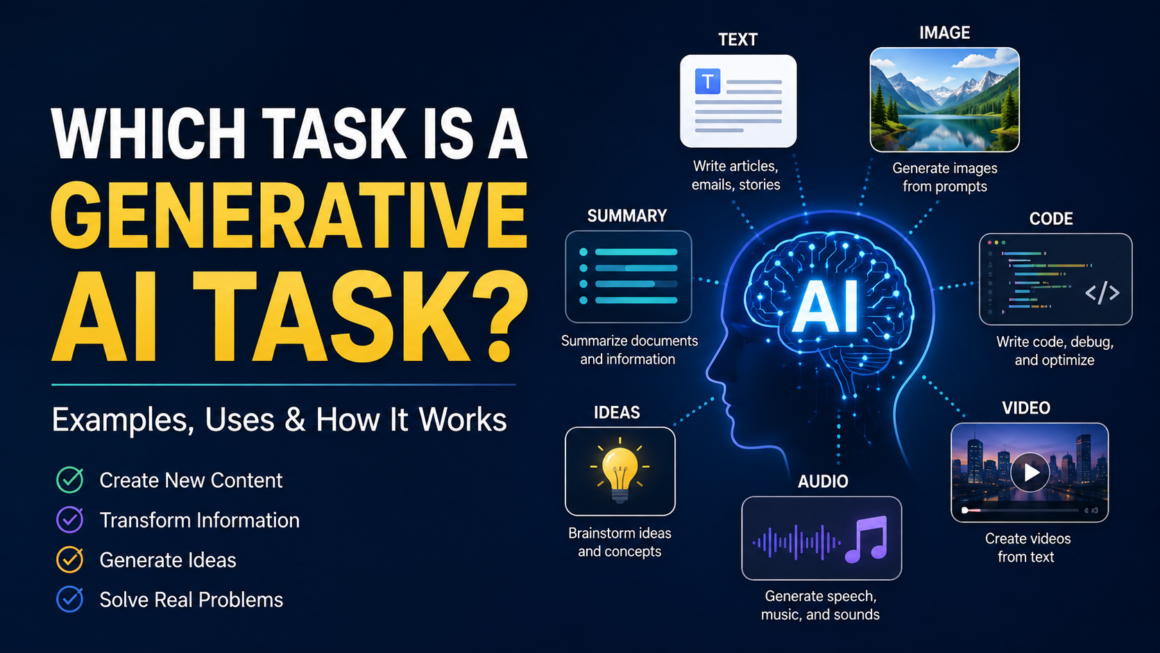
If you’re trying to answer “which task is a generative AI task?”, the simplest rule is this: a task is generally considered generative AI when the system is asked to create new content or transform existing information into a new output.
Writing an email, generating an image from a prompt, creating computer code, producing a video, composing music, or summarizing a document can all involve generative AI. By contrast, tasks such as detecting spam, classifying an image, or predicting next month’s sales are generally associated with classification or predictive AI rather than generation.
Generative AI has expanded far beyond text. Modern systems can generate text, images, video, audio, software code, and other digital content. NIST defines generative AI as a class of AI models that can generate derived synthetic content, including images, video, audio, text, and other digital content.
In this guide, we’ll explain exactly what qualifies as a generative AI task, provide real-world examples, compare generative AI with traditional AI, and show you how to identify a generative AI task yourself.
Which Task Is a Generative AI Task?
A generative AI task is a task in which an AI system creates new content or produces a transformed output from an input, usually based on a prompt or other instructions.
Common examples include:
- Writing an article from a topic
- Creating an image from a text prompt
- Generating computer code
- Drafting an email
- Creating a product description
- Producing or editing video
- Generating speech or music
- Summarizing a document
- Rewriting content in a different style
- Brainstorming ideas
The key distinction is generation. The AI isn’t merely identifying, predicting, or categorizing something. It is producing an output.
For example, asking an AI model to write a 500-word product description is a generative AI task because the model produces new text. Asking a machine-learning model whether a customer is likely to cancel a subscription is primarily a predictive task.
The simplest way to identify a generative AI task
Ask one question:
Does the AI system need to create new content or substantially transform existing content?
If the answer is yes, the task may be a generative AI task.
If the system’s primary job is to classify, predict, detect, or make a decision, it may be using another type of AI instead.
This distinction isn’t absolute in every application. A single product can combine generative and predictive models, and a generative model can perform tasks that look analytical. The important point is to identify what the model is being asked to produce.
What Is Generative AI?
Generative artificial intelligence, commonly called GenAI, is a category of AI designed to generate new content based on patterns learned from data.
NIST describes generative AI as AI models that emulate characteristics of input data to generate derived synthetic content. The outputs can include text, images, videos, audio, and other forms of digital content.
IBM similarly describes generative AI as AI capable of creating content such as text, images, video, audio, and software code in response to a user’s prompt or request.
How does generative AI work?
At a high level, a generative AI system typically involves:
- Training – The underlying model learns patterns and relationships from large amounts of data.
- Model development and tuning – The model is adapted to perform useful tasks and respond appropriately to inputs.
- Prompt or input – A user or application provides instructions, data, or context.
- Generation – The model produces an output based on its learned patterns and the provided input.
- Evaluation and refinement – The output can be reviewed, corrected, or regenerated.
Large language models are a common type of foundation model used for text-generation applications, while other models can generate images, video, audio, code, or multiple modalities.
What can generative AI create?
Generative AI can produce many different types of content, including:
- Text
- Images
- Video
- Audio
- Music
- Computer code
- Synthetic data
- Presentations and documents
- Creative concepts
NIST’s current GenAI evaluation work also covers multiple modalities, including text, image, code, audio, and video.
What Are Examples of Generative AI Tasks?
The easiest way to understand generative AI is to look at practical tasks.
1. Generating written content
Writing is one of the most recognizable generative AI applications.
For example, an AI system can be asked to:
- Write a blog introduction
- Draft an email
- Create a product description
- Generate social media captions
- Write an outline
- Create a marketing advertisement
- Draft a business proposal
- Rewrite an existing paragraph
Suppose you enter:
“Write a 150-word product description for a wireless headset aimed at remote workers.”
The model generates a new piece of text based on your instructions.
That’s a generative AI task.
2. Creating images from text
Image generation is another clear example.
A user might enter:
“Create a photorealistic image of a modern office with employees collaborating around a large screen.”
A text-to-image system can generate an image based on that description.
This qualifies as generative AI because the system creates visual content rather than simply classifying an existing image.
3. Generating computer code
Generative AI can also create software code.
For example, a developer might ask:
“Write a Python function that converts a CSV file into a JSON file.”
The AI can generate a proposed implementation.
Other examples include:
- Generating SQL queries
- Creating HTML and CSS
- Writing JavaScript functions
- Generating unit tests
- Producing documentation
- Suggesting debugging fixes
- Converting code from one programming language to another
NIST’s GenAI evaluation program specifically includes code-generation reliability among the areas being evaluated.
Generated code still needs human review, testing, and security checks before being used in production.
4. Creating or transforming audio
Generative AI can generate or transform audio.
Examples include:
- Text-to-speech
- Synthetic voices
- Music generation
- Audio effects
- Voice transformation
- Narration
For example, converting a written script into natural-sounding speech involves generating an audio output from text.
5. Generating video
Video generation is another increasingly important generative AI task.
A system may generate video from:
- Text prompts
- Images
- Existing video
- Storyboards
- Structured instructions
Possible applications include marketing videos, product concepts, educational material, visual effects, and creative experimentation.
6. Summarizing information
Is summarization a generative AI task?
It can be.
When a generative AI model reads a long document and produces a shorter summary in its own generated output, the system is creating new text based on the source material.
For example:
Input:
A 20-page business report.
Instruction:
“Summarize the report in five bullet points for an executive.”
Output:
A newly generated five-point summary.
The distinction matters because not every form of information extraction is necessarily generative. A system that simply retrieves predefined sentences from a database is doing something different from a model that generates a new summary.
Which Tasks Are Not Generative AI Tasks?
Understanding what isn’t generative AI is just as important.
Classification
Classification involves assigning something to a category.
For example:
“Is this email spam or not spam?”
The system is primarily classifying the email.
That’s generally a classification task rather than a generative AI task.
Prediction
Prediction involves estimating a future or unknown outcome.
For example:
“What will next month’s sales revenue be?”
A predictive model may use historical sales data to estimate a future value.
The primary output is a prediction, not newly generated content.
Fraud detection
A financial system might analyze transactions and identify those that appear suspicious.
For example:
“Does this transaction look fraudulent?”
The system is detecting or classifying a potential risk.
That is different from asking a generative AI model to write a report explaining a detected fraud pattern.
Rule-based automation
Consider a workflow that automatically sends a confirmation email after someone submits a form.
If the email is a fixed template triggered by a rule, the workflow itself isn’t necessarily generative AI.
However, if a generative model creates a personalized response based on the customer’s message, the generation component becomes a generative AI task.
Why does this distinction matter?
The term AI covers a very broad range of technologies.
NIST’s definition of AI includes machine-based systems capable of making predictions, recommendations, or decisions based on human-defined objectives. Generative AI represents a particular category focused on generating content.
So:
AI is the broader category. Generative AI is one type of AI.
Generative AI vs. Traditional AI: What’s the Difference?
A simple comparison makes the difference clearer.
| Feature | Generative AI | Traditional/Predictive AI |
| Primary purpose | Create or transform content | Predict, classify, detect, or decide |
| Typical output | Text, images, code, audio, video | Category, score, prediction, recommendation |
| Example | Write an article | Predict customer churn |
| Example | Generate an image | Detect objects in an image |
| Example | Write software code | Detect a software anomaly |
| User interaction | Often prompt-based | Often data/model-based |
| Output variability | Can produce different outputs | Usually designed for consistent predictions |
The distinction isn’t about whether the system is “smart.” It’s about what the system is designed to produce.
The U.S. Congressional Research Service similarly distinguishes GenAI from AI systems whose primary goals include classifying data or making decisions. It notes that GenAI can generate text, images, videos, computer code, and music.
Can a Task Use Both Generative and Traditional AI?
Yes.
Real-world AI systems don’t always fit into a single category.
Consider a customer-support platform.
A predictive model might determine:
“This customer is at high risk of churn.”
A generative AI model could then create:
“Write a personalized response offering helpful resources to this customer.”
The first is primarily predictive.
The second is generative.
Together, they can form a more sophisticated workflow.
This distinction is becoming particularly important as AI systems evolve beyond simple chat interfaces into applications that can reason, retrieve information, use tools, and complete multi-step workflows.
What Business Tasks Can Generative AI Handle?
Generative AI is useful across many business functions because so much knowledge work involves creating, transforming, or communicating information.
Marketing
Marketing teams can use generative AI to help with:
- Content ideas
- Blog outlines
- Ad copy variations
- Email drafts
- Product descriptions
- Social media concepts
- Creative briefs
- Campaign brainstorming
The human marketer should still review brand accuracy, factual claims, positioning, and compliance.
Customer support
Generative AI can assist with:
- Drafting customer responses
- Summarizing conversations
- Creating knowledge-base content
- Rewriting responses in different tones
- Answering questions using approved information
For high-stakes or sensitive support situations, human oversight remains important.
Software development
Developers can use GenAI for:
- Code generation
- Code explanation
- Test generation
- Documentation
- Refactoring suggestions
- SQL generation
- Debugging assistance
Generated code should be tested and reviewed because plausible-looking code can still contain bugs or security problems.
Sales
Sales teams can use generative AI to create:
- Outreach drafts
- Proposal sections
- Follow-up emails
- Call summaries
- Account-research summaries
- Meeting preparation notes
Human resources
Potential applications include:
- Job-description drafts
- Interview-question generation
- Employee communication
- Training-material creation
- Policy-document summaries
Organizations should be particularly careful with sensitive employee information and decisions affecting individuals.
How Do You Know If a Task Is Suitable for Generative AI?
You can use a simple five-question test.
Step 1: Does the task require creating content?
If the answer is yes, GenAI may be suitable.
Examples:
- Write
- Design
- Generate
- Draft
- Compose
- Create
Step 2: Does the task have a clear input or prompt?
Generative systems generally need instructions, context, examples, source material, or another form of input.
Step 3: Can the output be reviewed by a human?
For many business applications, human review provides an important quality and risk-control layer.
Step 4: Is transformation involved?
Generative AI isn’t limited to creating something from nothing.
It can also transform existing information.
Examples include:
- Summarizing
- Rewriting
- Translating
- Changing tone
- Converting formats
- Turning notes into a report
Step 5: What happens if the AI is wrong?
This question is especially important.
A slightly imperfect social media caption may be easy to fix.
An incorrect medical, legal, financial, security, or employment-related output can have much more serious consequences.
NIST’s Generative AI Profile highlights the need to identify and manage risks associated with generative AI throughout the AI lifecycle.
What Are the Benefits of Generative AI Tasks?
When applied appropriately, generative AI can provide several practical benefits.
Faster content production
AI can generate initial drafts quickly, allowing people to spend more time reviewing, editing, and improving the final result.
Idea generation
Generative AI can produce multiple starting points for:
- Headlines
- Campaign concepts
- Product ideas
- Stories
- Designs
- Business strategies
Personalization
A system can potentially generate different messages for different audiences when it has appropriate context and safeguards.
Rapid prototyping
Teams can quickly turn an idea into a draft, mockup, code sample, or concept.
Workflow assistance
Generative AI can reduce repetitive writing and transformation work, particularly when outputs are relatively easy for humans to review.
However, faster generation does not automatically mean better results. Quality depends on the model, prompt, available context, workflow design, and human oversight.
What Are the Limitations of Generative AI?
Generative AI is powerful, but it isn’t infallible.
Hallucinations and factual errors
A generative model can produce an answer that sounds convincing but contains incorrect information.
This is why important factual claims should be verified against reliable sources.
Bias
Models can reproduce or amplify problematic patterns present in their training data or surrounding systems.
Privacy concerns
Users should be careful about entering confidential, personal, proprietary, or regulated information into AI systems unless the relevant data protections and organizational policies allow it.
Copyright and intellectual-property concerns
AI-generated or AI-assisted content can raise questions involving copyright, licensing, ownership, and use of third-party material.
The exact legal position can depend on the jurisdiction, facts, and applicable law.
Inconsistent output
The same prompt can sometimes produce different results.
This can be useful for brainstorming but problematic when an application requires predictable behavior.
Human judgment is still important
Generative AI can assist with content creation, but it doesn’t eliminate the need for human expertise.
NIST’s GenAI risk-management guidance emphasizes identifying and managing risks associated with generative AI systems rather than assuming that generated outputs are automatically trustworthy.
Key Takeaways: Which Tasks Are Generative AI Tasks?
Here’s the simple version:
- Writing new text is a generative AI task.
- Creating an image from a prompt is a generative AI task.
- Generating software code is a generative AI task.
- Creating audio or video can be a generative AI task.
- Summarizing a document into newly generated text can be a generative AI task.
- Classifying an email as spam is primarily a classification task.
- Predicting future sales is primarily a predictive task.
- Detecting suspicious transactions is primarily a detection/classification task.
- A single AI application can combine generative and non-generative techniques.
The most useful test is simple:
If the primary purpose is to generate new or transformed content, you’re likely dealing with a generative AI task.
Frequently Asked Questions About Generative AI Tasks
What is an example of a generative AI task?
Writing a blog post from a user prompt is a straightforward example of a generative AI task. Other examples include creating images, generating computer code, producing audio or video, drafting emails, and creating summaries from source material.
Which task is best suited for generative AI?
Tasks involving content creation, transformation, brainstorming, drafting, summarization, coding, and creative generation are generally well suited to generative AI. The best use case depends on output quality requirements, available context, risks, and the need for human review.
Is summarization a generative AI task?
Yes, it can be. When a generative AI model creates a new, shorter version of a source document, it is generating new text from the source information. However, simple retrieval of an existing summary is not necessarily a generative task.
Is image generation a generative AI task?
Yes. Creating a new image from a text prompt is a classic generative AI task. The system generates visual content based on instructions and learned patterns.
Is predicting sales a generative AI task?
Usually, no. Sales forecasting is primarily a predictive task because the model is estimating a future outcome. Generative AI could still be used to explain or summarize the resulting forecast.
Is spam detection a generative AI task?
Generally, no. Spam detection is primarily a classification task because the system determines whether a message belongs to a particular category.
Can generative AI generate code?
Yes. Code generation is a major generative AI application. A model can produce code based on natural-language instructions, explain existing code, suggest changes, or generate tests. Generated code should be reviewed and tested before deployment.
What is the difference between AI and generative AI?
AI is a broad field that includes systems designed to make predictions, recommendations, classifications, or decisions. Generative AI is a subset focused on generating new or transformed content such as text, images, audio, video, or code.
Final Answer: Which Task Is a Generative AI Task?
A task is generally a generative AI task when the AI system is asked to create new content or transform existing information into a new output.
If an AI writes an email, creates an image, generates code, produces a video, synthesizes audio, or creates a summary, it is performing a generative task.
If the system is instead predicting sales, detecting fraud, classifying spam, or identifying an object, the primary task is usually predictive, classification-based, or detection-oriented.
The distinction becomes particularly useful when deciding where generative AI belongs in a business workflow. Rather than asking whether a task simply “uses AI,” ask what the AI is expected to produce.
For ByteBenz readers, that’s the practical takeaway: generation is the defining characteristic to look for.


1 comment