
Artificial intelligence is becoming part of everyday business operations, but simply adding an AI tool to your technology stack does not always solve the problems that matter most.
Businesses often have unique workflows, proprietary data, specialized customers, and systems that generic AI products cannot fully accommodate. That’s where custom AI software development comes in. Instead of adapting business processes around an existing tool, companies can build AI-powered software around their specific requirements.
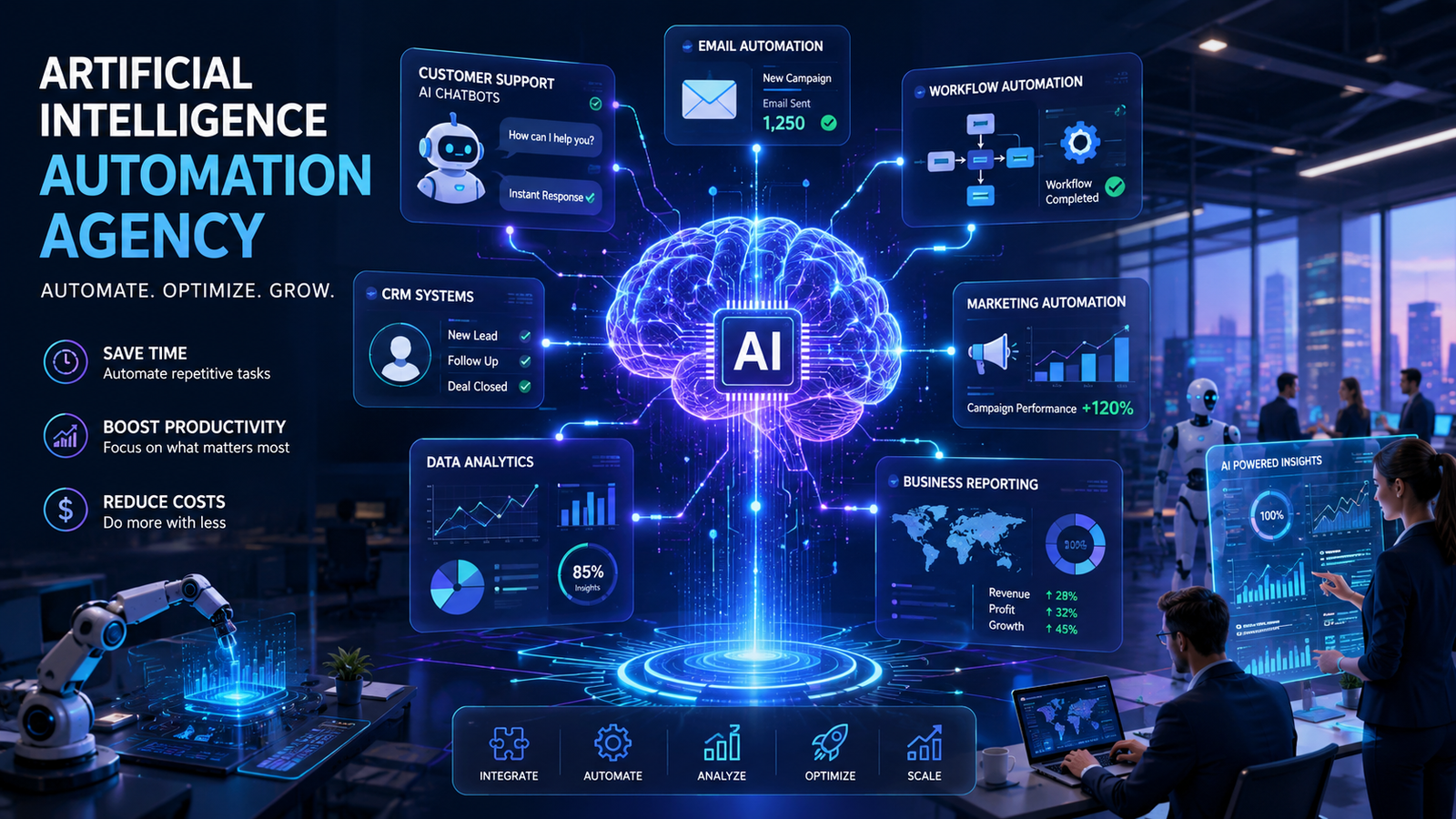
Custom AI development can automate repetitive work, analyze business data, assist employees, improve customer experiences, and connect AI capabilities directly to existing applications and workflows.
This guide explains what custom AI software development is, how the development process works, which technologies are involved, common business use cases, development costs, challenges, and how to determine whether custom AI is right for your organization.
What Is Custom AI Software Development?
Custom AI software development is the process of designing and building software that uses artificial intelligence to address specific business requirements, workflows, data, and user needs.
Unlike a standard AI application designed for a broad audience, custom AI software is built around a particular organization’s objectives. It can combine AI models with business databases, APIs, internal documents, automation workflows, analytics systems, and existing software.
For example, a company could develop an internal AI application that understands its documentation, answers employee questions, retrieves information from internal systems, and automatically creates reports.
Custom AI software can use different forms of artificial intelligence, including:
- Generative AI
- Large language models (LLMs)
- Machine learning
- Natural language processing
- Computer vision
- Predictive analytics
- AI agents
- Recommendation systems
- Intelligent automation
The technology selected depends on the problem being solved.
How Is Custom AI Software Different From Regular Software?
Traditional software generally follows predefined rules and workflows. AI-powered software can additionally identify patterns, interpret information, generate responses, make predictions, or adapt its output based on data.
For example, traditional software might require an employee to manually search thousands of documents using predefined filters. An AI-powered system could allow the employee to ask a natural-language question and retrieve relevant information automatically.
The goal isn’t to replace conventional software engineering. Instead, custom AI development combines traditional software development with AI capabilities.
What Can Custom AI Software Do?
Depending on the use case, custom AI software can:
- Automate repetitive business processes
- Analyze large volumes of data
- Extract information from documents
- Generate text and summaries
- Answer customer or employee questions
- Predict trends and outcomes
- Recommend products or actions
- Search internal knowledge
- Classify information
- Detect patterns and anomalies
- Support business decisions
- Coordinate multi-step workflows through AI agents
Why Are Businesses Investing in Custom AI Software?
The strongest reason to build custom AI software isn’t simply that AI is popular. It’s that AI can solve a specific business problem more effectively when it’s integrated into the organization’s existing processes.
Automate Complex Workflows
Many business processes involve repetitive tasks spread across multiple systems.
For example, an employee might need to:
- Receive a customer request.
- Review documents.
- Search a database.
- Check company policies.
- Create a response.
- Update a CRM.
- Send a follow-up.
A custom AI application could automate some of these steps while keeping human approval where it is necessary.
Improve Employee Productivity
AI can help employees spend less time searching, summarizing, categorizing, and processing information.
An internal AI assistant, for example, could help employees find information across company documentation without manually searching through multiple systems.
The objective isn’t necessarily to remove employees from the process. In many cases, the better approach is to give employees faster access to information and automate low-value administrative work.
Deliver More Personalized Customer Experiences
Custom AI software can use customer information and business rules to create more relevant interactions.
Potential applications include:
- AI customer support assistants
- Personalized recommendations
- Intelligent search
- Automated onboarding
- Customer sentiment analysis
- AI sales assistants
Because the system can be connected to business-specific information, it can provide experiences that generic AI tools may not be able to deliver.
Turn Business Data Into Actionable Insights
Businesses often have valuable information stored across databases, spreadsheets, CRM systems, documents, and other applications.
Custom AI software can bring these data sources together and help users identify patterns, summarize information, generate reports, or support decisions.
Build Competitive Differentiation
Off-the-shelf AI tools are available to many businesses. Custom software can provide capabilities designed around a company’s unique processes.
That can create differentiation when the software solves a problem that generic products don’t address effectively.
Custom AI Software vs. Off-the-Shelf AI Tools
Custom development isn’t automatically better than an existing AI product.
For common requirements, an off-the-shelf solution can be faster and more affordable. Custom development becomes more attractive when a business has specialized requirements, proprietary data, complex integrations, or workflows that standard products cannot support.
| Factor | Custom AI Software | Off-the-Shelf AI Tool |
| Customization | High | Usually limited |
| Business workflows | Purpose-built | Predefined |
| Integrations | Built around requirements | Depends on available integrations |
| User experience | Fully customizable | Standardized |
| Data control | Greater architectural control | Vendor-dependent |
| Scalability | Designed for requirements | Depends on provider |
| Upfront investment | Usually higher | Usually lower |
| Best suited for | Specialized problems | Common use cases |
When Should You Choose Custom AI Software?
Custom development may make sense when:
- Your workflow is highly specialized.
- Existing tools require too many compromises.
- You need deep integration with internal systems.
- Your business depends on proprietary data.
- You need a customized user experience.
- AI is a core part of your product.
- You need greater control over architecture and functionality.
- Your application needs to scale around specific business requirements.
When Is an Existing AI Tool Better?
An existing solution may be better when:
- Your requirements are standard.
- You need something quickly.
- You have a limited development budget.
- You don’t need extensive customization.
- The existing product already integrates with your systems.
- AI isn’t a core differentiator for your business.
The smartest strategy is often to evaluate the business problem first and choose custom development only when it provides a meaningful advantage.
How Does Custom AI Software Development Work?
A successful custom AI project starts with the business problem—not with choosing an AI model.
The development process typically includes the following stages.
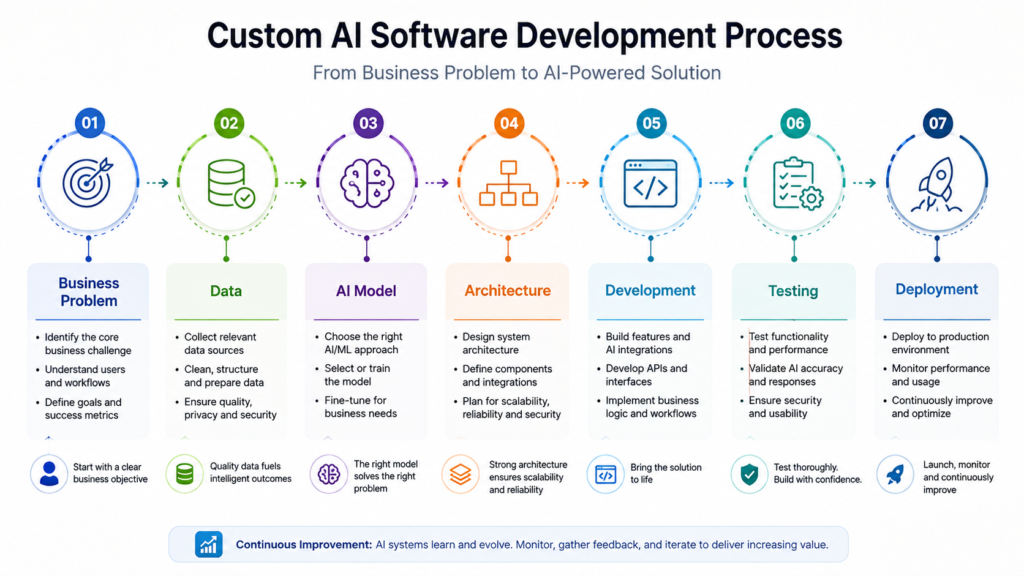
Step 1: Identify the Business Problem
Before selecting a technology, define what the software needs to accomplish.
Ask:
- What problem are we solving?
- Who will use the software?
- Which workflow needs improvement?
- What tasks should AI handle?
- What should remain under human control?
- How will success be measured?
For example, “We want an AI chatbot” is a technology requirement.
“We want to reduce the time employees spend searching internal documentation” is a business problem.
The second statement gives a development team a much stronger foundation.
Step 2: Define AI Use Cases and Requirements
Once the business problem is clear, identify where AI can provide value.
Possible AI capabilities include:
- Text generation
- Document analysis
- Classification
- Prediction
- Recommendation
- Conversational interfaces
- Knowledge retrieval
- Workflow automation
- Computer vision
- AI agents
Not every workflow requires an LLM or generative AI. Some problems may be better solved with traditional machine learning, rules-based automation, or a combination of technologies.
Step 3: Collect and Prepare Business Data
AI performance depends heavily on the quality and availability of relevant data.
Potential data sources include:
- Databases
- Internal documents
- Customer records
- CRM data
- Transaction data
- Product catalogs
- Knowledge bases
- Support tickets
- APIs
- Business applications
Data may need to be cleaned, structured, labeled, transformed, or securely connected before it can be used.
Why Does Data Quality Matter for AI Software?
Poor-quality data can lead to unreliable outputs.
If the information provided to an AI system is incomplete, outdated, inconsistent, or incorrectly structured, the resulting application may produce inaccurate or misleading results.
Data preparation should therefore be treated as a core part of the project rather than an afterthought.
Step 4: Choose the Right AI Model and Technology
There is no universally “best” AI model for every application.
The appropriate technology depends on factors such as:
- Accuracy requirements
- Response speed
- Data sensitivity
- Context requirements
- Infrastructure
- Operating cost
- Scalability
- Integration requirements
- Deployment environment
Depending on the application, a development team may use an existing foundation model, an open-source model, fine-tuning, retrieval-augmented generation, traditional machine learning, or a combination of these approaches.
The goal should be to select technology based on the application’s requirements—not simply the newest model available.
Step 5: Design the AI Software Architecture
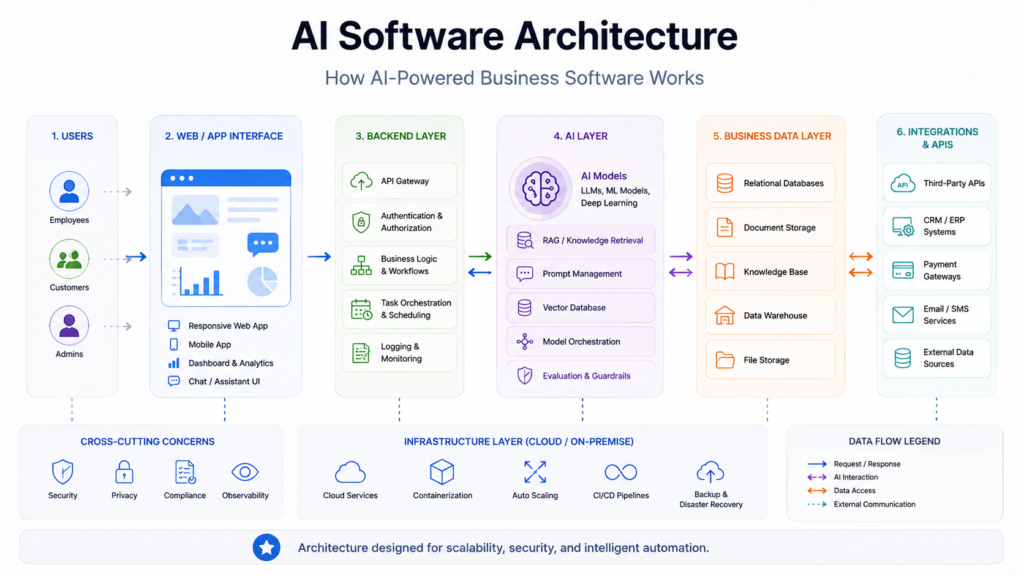
The next step is determining how the different components will work together.
A typical AI application might look like:
Users → Application Interface → Backend → AI Layer → Business Data/Knowledge → APIs
The architecture may include:
- Frontend application
- Backend services
- AI model or API
- Database
- Vector database
- Authentication
- Business APIs
- Cloud infrastructure
- Monitoring
- Security controls
For knowledge-intensive applications, retrieval-augmented generation (RAG) can allow an AI system to retrieve relevant information from a business knowledge base before generating an answer.
Step 6: Develop the Software
Development combines conventional software engineering with AI integration.
The development team may build:
- User interfaces
- Backend services
- APIs
- Database connections
- Authentication systems
- AI workflows
- Automated processes
- Administrative dashboards
- Reporting systems
- AI agent workflows
The AI component should be integrated into the actual business process rather than operating as an isolated feature.
Step 7: Test AI Accuracy and Software Performance
AI software requires more than traditional functional testing.
Testing may include:
- Functional testing
- Security testing
- Performance testing
- User acceptance testing
- AI output evaluation
- Edge-case testing
- Hallucination testing
- Integration testing
For AI applications, developers should evaluate not only whether the application works technically, but also whether the AI produces useful and reliable outputs.
Step 8: Deploy, Monitor, and Improve
Launching the software is not the end of AI development.
After deployment, teams should monitor:
- AI output quality
- Application performance
- Usage
- Errors
- Infrastructure costs
- Response times
- User feedback
- Model behavior
AI applications may need ongoing improvements as business requirements, data, models, and user expectations change.
What Technologies Are Used in Custom AI Software Development?
Different projects require different technology stacks.
Large Language Models and Generative AI
LLMs can power:
- AI assistants
- Content generation
- Summarization
- Question answering
- Document analysis
- Natural-language interfaces
Machine Learning Models
Traditional machine learning can be useful for:
- Forecasting
- Classification
- Fraud detection
- Risk scoring
- Recommendation systems
- Predictive analytics
Retrieval-Augmented Generation
RAG combines an AI model with an external knowledge source.
Instead of relying entirely on the model’s existing knowledge, the application retrieves relevant business information and provides it to the model as context.
This can be useful for internal knowledge assistants, documentation search, customer support, and other information-heavy applications.
AI Agents
AI agents can perform multi-step tasks based on defined objectives and available tools.
For example, an agent might interpret a request, retrieve information, interact with business systems, and complete a workflow.
However, agent-based systems should have appropriate permissions, controls, monitoring, and human oversight where necessary.
APIs, Databases, and Cloud Infrastructure
AI rarely operates alone.
Custom AI software may need to connect with:
- CRM platforms
- ERP systems
- Payment systems
- Databases
- Internal APIs
- Cloud services
- Analytics platforms
- Communication tools
These integrations allow AI capabilities to become part of actual business workflows.
What Are the Best Use Cases for Custom AI Software?
Custom AI can support many business functions.
AI Customer Support Software
Businesses can build AI systems that answer questions, retrieve relevant information, classify support requests, and assist human agents.
Intelligent Sales and CRM Software
AI can help sales teams summarize customer information, prioritize leads, generate follow-ups, and surface relevant insights.
AI-Powered Document Processing
Custom AI applications can extract and organize information from documents such as forms, contracts, invoices, and reports.
Predictive Analytics Software
Businesses can use machine learning to identify patterns and generate forecasts based on historical and operational data.
AI Knowledge Management
An internal AI knowledge system can help employees find answers across company documentation, policies, procedures, and other information sources.
AI Workflow Automation
AI can be integrated into workflows where employees currently spend significant time reviewing, categorizing, summarizing, or routing information.
AI Recommendation Systems
Recommendation engines can use customer behavior, product information, and business rules to provide personalized suggestions.
AI Assistants and Agents
Custom assistants and agents can be designed around specific business roles, workflows, and permissions.
How Much Does Custom AI Software Development Cost?
There is no single price for custom AI software development.
A simple AI-enabled application and a complex enterprise platform can have dramatically different development requirements.
What Factors Affect AI Software Development Cost?
Major cost factors include:
- Number of features
- Application complexity
- AI model requirements
- Data preparation
- Model customization
- Third-party integrations
- UI/UX requirements
- Security requirements
- Infrastructure
- Testing
- Development team
- Scalability
- Ongoing maintenance
A practical way to estimate cost is to divide the project into stages:
Discovery → Prototype → MVP → Production → Optimization
This approach can help businesses validate the concept before committing to a larger production system.
How Long Does It Take to Build Custom AI Software?
Development time depends on the scope.
A proof of concept may require significantly less time than a production-ready enterprise platform.
The timeline can be affected by:
- Number of integrations
- Data readiness
- AI complexity
- UI requirements
- Security requirements
- Testing
- Compliance considerations
- Number of users
- Infrastructure requirements
Instead of asking only, “How quickly can we build it?” businesses should also ask whether the software can be tested, secured, maintained, and scaled properly.
What Challenges Should Businesses Consider?
Custom AI software can create significant value, but it also introduces technical and operational challenges.
Data Privacy and Security
Sensitive business and customer information must be handled carefully.
Applications should use appropriate authentication, authorization, encryption, data-handling policies, and security controls.
AI Accuracy and Hallucinations
Generative AI systems can sometimes produce incorrect information.
High-impact applications should therefore include evaluation mechanisms and appropriate human oversight.
Integration Complexity
Connecting AI software with existing business systems can be more complicated than building a standalone application.
Legacy software, inconsistent APIs, outdated databases, and fragmented workflows can all affect implementation.
AI Infrastructure Costs
AI workloads can create ongoing costs related to model usage, storage, computing, monitoring, and data processing.
Architecture should therefore consider both performance and operational cost.
Scalability
A system that works for 100 users may require architectural changes when usage grows significantly.
Scalability should be considered during the initial design rather than only after the application becomes successful.
Model Dependence and Vendor Lock-In
Relying heavily on one model or provider can create dependencies.
Where appropriate, businesses should consider architectural flexibility and portability.
Ongoing Maintenance
AI software requires maintenance just like other software—but AI applications may also require model evaluation, prompt or workflow updates, data updates, and performance monitoring.
Best Practices for Building Custom AI Software
A strong AI development strategy should follow several principles.
Start With a Measurable Business Problem
Don’t build AI simply because you can.
Define the business outcome first.
Define Success Metrics
Choose measurable indicators such as:
- Processing time
- Response time
- Accuracy
- Cost per task
- Customer resolution rate
- Employee productivity
- Conversion rate
Use High-Quality Data
Data quality should be addressed early in the project.
Choose Models Based on Requirements
The most advanced model isn’t automatically the most appropriate choice.
Consider accuracy, latency, cost, privacy, and scalability.
Build Security Into the Architecture
Security should be considered during design, development, testing, and deployment.
Keep Humans Involved Where Appropriate
High-impact decisions may require human review rather than completely autonomous AI decisions.
Monitor the Application After Launch
Track AI performance and user feedback continuously.
Plan for Long-Term Maintenance
AI software should be designed with future model updates, changing business requirements, and increasing usage in mind.
How Do You Choose a Custom AI Software Development Partner?
Choosing the right development partner is an important part of the project.
Look for a team that understands both AI technology and conventional software engineering.
Evaluate AI and Software Engineering Expertise
A good partner should understand AI models, APIs, databases, application architecture, security, deployment, and maintenance.
Ask About Their Development Process
A clear process should cover:
Discovery → Requirements → Architecture → Development → Testing → Deployment → Optimization
Review Relevant Case Studies
Look for experience solving problems similar to yours rather than simply counting the number of AI projects completed.
Assess Data Security Practices
Ask how sensitive business data is stored, transferred, accessed, and protected.
Understand Post-Launch Support
AI software needs monitoring and maintenance after launch. Make sure the development partner can support the application beyond the initial release.
Ask How They Measure AI Performance
A capable partner should be able to explain how they will evaluate output quality, reliability, latency, cost, and business outcomes.
Key Takeaways
- Custom AI software development creates AI-powered applications around specific business requirements.
- Custom AI can combine business data, workflows, APIs, automation, and AI models.
- The development process should begin with a clearly defined business problem.
- AI model selection should be based on application requirements rather than popularity.
- Data quality, security, testing, and monitoring are critical to successful AI software.
- Custom development isn’t always the best option; existing AI tools may be more practical for standardized needs.
- Businesses should measure AI projects using clear operational and financial outcomes.
- AI software should be treated as an evolving product that requires ongoing optimization.
Frequently Asked Questions About Custom AI Software Development
What is custom AI software development?
Custom AI software development is the process of building software that uses artificial intelligence to solve specific business problems. It combines AI capabilities such as machine learning or generative AI with application features, business data, workflows, APIs, and integrations designed around an organization’s requirements.
How does custom AI software development work?
Custom AI software development typically involves identifying a business problem, defining requirements, preparing data, selecting AI technologies, designing the software architecture, developing the application, testing AI performance, deploying the system, and continuously monitoring and improving it.
How much does custom AI software development cost?
The cost depends on factors such as software complexity, AI model requirements, data preparation, integrations, security, infrastructure, testing, and scalability. A small AI-enabled application can have very different requirements from an enterprise AI platform, so project-specific estimation is generally more useful than a fixed price.
How long does it take to build custom AI software?
The timeline depends on the scope and complexity of the project. A proof of concept or MVP can be developed more quickly than a production-grade enterprise application. Data readiness, integrations, AI requirements, security, testing, and scalability can all affect the development timeline.
What is the difference between AI custom software development and traditional software development?
Traditional software primarily relies on predefined rules and logic, while AI software can use machine learning, language models, prediction, or other AI capabilities to interpret data and generate intelligent outputs. Custom AI development combines these AI capabilities with conventional software engineering.
Can AI be integrated into existing business software?
Yes. AI can often be integrated into existing applications through APIs, databases, AI services, automation workflows, and custom backend development. The approach depends on the existing software architecture and the type of AI functionality required.
Should a small business build custom AI software?
A small business should consider custom AI when it has a specific problem that existing tools cannot adequately solve, particularly when the workflow, data, or customer experience requires significant customization. For common requirements, an existing AI product may be more practical and cost-effective.
What AI technologies are used to build custom software?
Custom AI software may use large language models, machine learning, generative AI, retrieval-augmented generation, AI agents, natural language processing, computer vision, APIs, databases, vector databases, and cloud infrastructure. The appropriate technology depends on the application’s requirements.
Is custom AI software secure?
Custom AI software can be designed with security controls such as authentication, authorization, encryption, access management, data protection, monitoring, and testing. Security requirements should be considered from the beginning of the architecture rather than added after development.
How do I choose a custom AI software development company?
Evaluate the provider’s AI expertise, software engineering capabilities, development process, relevant experience, security practices, communication, testing methodology, and post-launch support. Ask how the team will measure AI performance and how the software will be maintained as requirements evolve.
Ready to Explore Custom AI Software?
The best AI software projects don’t start with a model or a trendy technology. They start with a business problem worth solving.
If your organization has a workflow that is slow, repetitive, difficult to scale, or dependent on large amounts of business data, custom AI software may provide a way to improve it.
Start by defining the problem, users, data, desired outcome, and success metrics. From there, the right AI architecture and development approach can be evaluated.
Want to explore what AI-powered software could look like for your business? Connect with ByteBenz to discuss your requirements and identify a practical development approach.