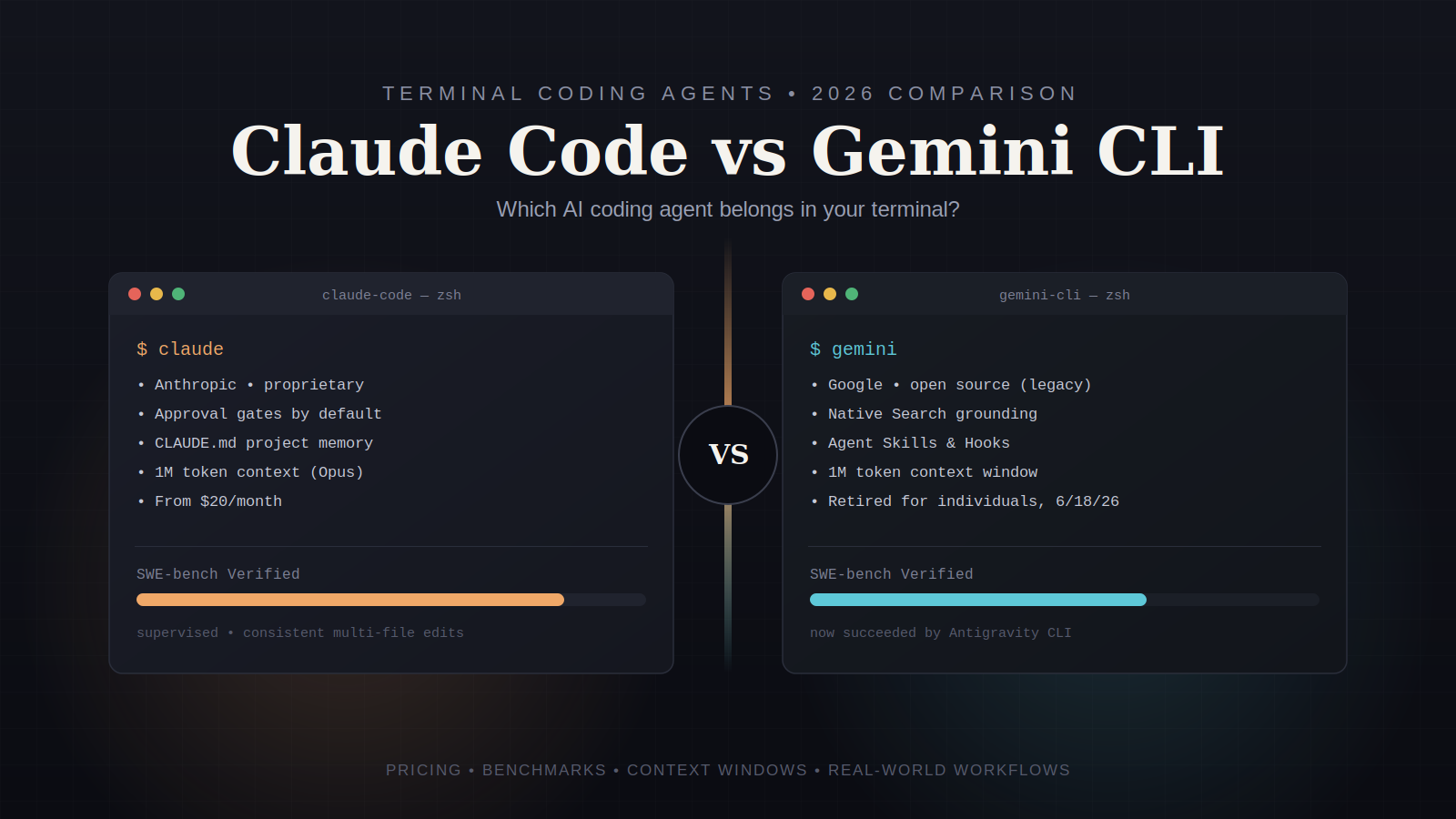



If you need one answer right now, choose Claude (Opus 4.8 or Sonnet 5) when your work centers on coding, long-form writing, or multi-step agent tasks that need careful reasoning. Choose Gemini (3.1 Pro) when your work depends on Google Search grounding, native multimodal input, or a 1-million-token context window at a lower price. Neither model is universally “better”—they’re built around different priorities, and the right pick depends on what you’re actually doing with it.
I’ve spent months running both models side by side on real client work: coding tickets, research summaries, long documents, and image-heavy tasks. This guide breaks down where each one wins, where each one falls short, and exactly how to decide between Claude vs Gemini for your specific use case.
Quick Answer Box
| If you need this… | Pick this |
| Best raw coding accuracy | Claude Opus 4.8 |
| Best value for daily coding/writing | Claude Sonnet 5 |
| Cheapest large-context processing | Gemini 3.1 Pro |
| Real-time web-grounded answers | Gemini 3.1 Pro |
| Long documents, video, or audio input | Gemini 3.1 Pro |
| Careful, structured long-form writing | Claude |
| Tight Google Workspace integration | Gemini |
| Enterprise agent workflows | Claude (slightly ahead on agentic benchmarks) |
Overview: What Are Claude and Gemini?
Claude is Anthropic’s family of large language models, built with a strong focus on reasoning quality, coding accuracy, and safety-conscious output. Anthropic positions Claude as the model of choice for developers, technical writers, and enterprises that need dependable, well-structured answers over flashy multimodal tricks.
Gemini is Google’s family of models, built natively multimodal from the ground up. Gemini reads text, images, audio, and video in the same context window and connects directly to Google Search, Google Workspace, and Google’s cloud infrastructure. Google positions Gemini as the everyday assistant for people already living inside Gmail, Docs, and Search.
Both companies release updates every few months, so “which one is better” changes fast. As of mid-2026, Anthropic’s current lineup includes Claude Sonnet 5 (the default workhorse model), Claude Opus 4.8 (the top reasoning and coding model), and the newer Fable 5 and Mythos 5 tier. Google’s current flagship is Gemini 3.1 Pro, alongside faster Flash variants for lower-cost tasks
Key Features Compared
Claude’s Core Strengths
- Coding accuracy. Claude consistently posts some of the strongest scores on SWE-bench Verified, a benchmark that tests real GitHub bug fixes rather than toy problems.
- Agentic reliability. Claude handles long, multi-step tasks—running tools, managing sub-agents, self-correcting—with fewer wasted steps.
- Writing structure. Claude tends to organize longer answers more clearly, with fewer contradictions across a long document.
- Prompt injection resistance. Anthropic has invested heavily in making Claude harder to manipulate through hidden instructions in documents or web pages, which matters for computer-use and browsing agents.
Gemini’s Core Strengths
- Native multimodality. Gemini was trained from the start on text, image, audio, and video together, so it handles mixed-media prompts (a screenshot plus a question, a video plus a summary request) more naturally.
- Massive context window. Every Gemini tier, down to the cheapest Flash-Lite model, supports up to a 1-million-token context window — enough to hold a large codebase or a full book in a single prompt.
- Search grounding. Gemini can tie answers directly to live Google Search results, which reduces outdated information on fast-moving topics.
- Ecosystem integration. If your team already runs on Gmail, Docs, Sheets, and Drive, Gemini shows up inside those tools without extra setup.
How It Works: Claude vs Gemini Under the Hood
Both models are transformer-based large language models trained on massive text (and, for Gemini, multimodal) datasets, then fine-tuned with human feedback and reinforcement learning to follow instructions safely.
The practical difference is in how each model reasons through a task:
- Claude models use an internal “extended thinking” mode for harder problems, where the model reasons step by step before producing a final answer. This tends to reduce careless mistakes on multi-step coding or math tasks.
- Gemini models use a similar internal reasoning process (Google calls it “Deep Think” on the Pro tier), but the model’s advantage shows up more in how it fuses different data types—text, images, and retrieved search results—into one coherent answer.
Neither approach is “more advanced” than the other. They’re optimized for different jobs: Claude for depth on a narrow, text-heavy task; Gemini for breadth across formats and freshness of information.
Claude vs Gemini: Full Comparison Table (2026)
| Category | Claude (Opus 4.8 / Sonnet 5) | Gemini (3.1 Pro) |
| Best for | Coding, agents, long-form writing | Multimodal tasks, search-grounded answers |
| Context window | Up to 1M tokens (Opus 4.8, Sonnet 5) | Up to 1M tokens (all tiers) |
| Coding benchmark (SWE-bench Verified) | Leads or near-ties the field | Very close second in most tests |
| Multimodal input | Text, image, limited video/audio | Native text, image, audio, video |
| Real-time web access | Via connected tools/search integration | Native Google Search grounding |
| API pricing (flagship) | $5 input / $25 output per million tokens (Opus 4.8) | $2 input / $12 output per million tokens (≤200K context) |
| Mid-tier pricing | Sonnet 5: $2–3 input / $10–15 output per million tokens | Flash tiers from ~$1.50 input |
| Prompt caching discount | Up to 90% | Up to 90% (input drops to ~$0.20/M) |
| Free access | Limited free tier in Claude apps | Generous free tier in Gemini app + AI Studio |
| Enterprise integration | AWS, Google Cloud, Microsoft Foundry | Google Workspace, Vertex AI |
| Safety focus | Heavy emphasis on prompt-injection resistance | Standard Google safety filtering |
Benchmark and pricing figures reflect publicly available data as of mid-2026 and change frequently—always check each provider’s official pricing page before budgeting a production deployment.
Gemini 2.5 Pro vs Claude 4 Opus (Legacy Comparison)
This match-up is now a generation behind, but it’s still worth understanding if you’re comparing archived benchmarks or maintaining an older integration.
Gemini 2.5 Pro was Google’s reasoning-focused model built around a 1-million-token context window and strong performance on math and multimodal reasoning benchmarks. It was priced competitively against Claude at the time, generally undercutting Anthropic’s flagship on a per-token basis.
Claude Opus 4 (and the follow-up Opus 4.1) was Anthropic’s flagship at $15 input / $75 output per million tokens—considerably more expensive than Gemini 2.5 Pro, but ahead on real-world coding tasks and long-horizon agent reliability.
The practical takeaway: teams choosing between these two generally picked Gemini 2.5 Pro for cost-sensitive, document-heavy workloads and Claude Opus 4 for coding-critical or agent-heavy products where the cost premium was justified by fewer failed runs. Both models have since been succeeded—Gemini 2.5 Pro is being phased out by Google in late 2026, and Claude Opus 4 was replaced first by Opus 4.5 (which cut pricing by roughly 67%) and now by Opus 4.8.
Gemini 2.5 Pro vs Claude Sonnet 4 (Legacy Comparison)
This was the more common real-world comparison, since both models targeted the same “everyday workhorse” price bracket rather than the top-of-line flagship tier.
- Claude Sonnet 4 matched or beat Gemini 2.5 Pro on coding-specific tasks and tended to produce more consistent, well-structured long documents.
- Gemini 2.5 Pro held an edge on tasks that combined images, PDFs, and text in one request, and it was frequently cheaper per output token.
- Neither model held a decisive lead in general reasoning—most independent testers described the two as close enough that workflow fit mattered more than raw benchmark scores.
If you’re still running Sonnet 4 or Gemini 2.5 Pro in production, it’s worth budgeting time to migrate: both companies have shipped at least two full generations since, with meaningful gains in coding accuracy, context length, and cost efficiency on both sides.
Gemini 3 vs Claude 4.5: The Current Generation
This is the comparison most people actually mean today. Google’s Gemini 3 Pro launched in November 2025, and Anthropic answered within a week with Claude Opus 4.5 and Sonnet 4.5. Both companies have since shipped incremental updates (Gemini 3.1 Pro and Claude Opus 4.6 through 4.8), but the core positioning from this launch window still holds.
Where Claude 4.5 (and its successors) lead:
- Coding accuracy on SWE-bench Verified, where Claude has consistently scored at or near the top of the field.
- Agentic task completion — Claude tends to need fewer tool calls and fewer retries to finish a complex, multi-step job.
- Token efficiency—Anthropic’s 4.5 generation produced noticeably shorter, more precise outputs than earlier Claude versions, which lowers real-world API costs even when the sticker price looks higher.
Where Gemini 3 leads:
- Pure reasoning benchmarks like GPQA Diamond, where Gemini 3 Pro posted some of the highest scores recorded at launch.
- Multimodal understanding, especially tasks mixing long video, audio, and text in a single prompt.
- Default context window size and lower cost per token, especially for high-volume, document-heavy workloads.
Bottom line for this comparison: if you’re weighing Gemini 3 against Claude 4.5 today, the honest answer is that both are excellent, and the deciding factor is almost always your workflow—not a small percentage-point gap on a benchmark leaderboard.
Pricing Breakdown
Pricing changes often for both companies, so treat these as directional figures rather than fixed numbers.
| Model | Input (per million tokens) | Output (per million tokens) | Context window |
| Claude Opus 4.8 | $5.00 | $25.00 | Up to 1M |
| Claude Sonnet 5 | $2.00 (intro, through Aug 31, 2026) → $3.00 | $10.00 → $15.00 | Up to 1M |
| Claude Haiku 4.5 | $1.00 | $5.00 | 200K |
| Gemini 3.1 Pro (≤200K context) | $2.00 | $12.00 | 1M |
| Gemini 3.1 Pro (>200K context) | $4.00 | $18.00 | 1M |
| Gemini Flash tiers | From ~$1.50 | From ~$7.50 | 1M |
Both providers offer prompt caching (up to ~90% savings on repeated context) and batch processing discounts (typically 50% off) for non-urgent, high-volume jobs. If you’re processing large documents repeatedly, caching matters more than the headline per-token price.
Consumer subscriptions follow a similar pattern: both Claude Pro and Google AI Pro sit in the $20/month range for individual users, with higher-tier plans (Claude Max, Google AI Ultra) aimed at power users who need higher usage caps.
Pros and Cons
Claude Pros
- Strong, consistent coding accuracy across real-world bug fixes, not just synthetic benchmarks
- Clear, well-structured long-form writing with fewer internal contradictions
- Efficient agent behavior — fewer wasted tool calls on complex tasks
- Meaningful safety investment, including resistance to prompt injection in browsing/agent use
Claude Cons
- More expensive at the flagship (Opus) tier than Gemini’s equivalent
- Weaker native video and audio understanding compared to Gemini
- Smaller ecosystem of built-in productivity integrations outside of developer tools
Gemini Pros
- Native multimodal input (text, image, audio, video) in one context window
- Lower cost per token at the flagship tier, especially under 200K context
- Deep integration with Google Search, Workspace, and Google Cloud
- 1-million-token context window available even on cheaper tiers
Gemini Cons
- Coding accuracy trails Claude on several real-world benchmarks, though the gap has narrowed
- Long-context pricing jumps meaningfully once you cross the 200K-token threshold
- Output style can be less consistent on long, structured documents compared to Claude
Best Use Cases for Each
Choose Claude when you’re:
- Building or maintaining a coding assistant, code review tool, or autonomous coding agent
- Writing long technical documents, reports, or research summaries that need internal consistency
- Running a multi-step agent that calls tools, checks its own work, and needs to avoid derailment
- Working in a regulated or security-sensitive environment where prompt-injection resistance matters
Choose Gemini when you’re:
- Analyzing large documents, spreadsheets, or codebases that exceed 200K tokens regularly
- Building an app that needs to understand video, audio, or mixed-media input natively
- Building on top of Google Workspace, Google Cloud, or Google Search
- Running high-volume, cost-sensitive pipelines where per-token pricing directly affects margins
Who Should Use Which Model
| User Type | Recommended Model | Why |
| Software engineers/coding teams | Claude Sonnet 5 or Opus 4.8 | Higher real-world coding accuracy, fewer wasted agent steps |
| Content marketers/writers | Claude | More consistent structure across long drafts |
| Data analysts working with huge documents | Gemini 3.1 Pro | 1M-token context at a lower cost per token |
| Google Workspace-heavy teams | Gemini | Built directly into Docs, Sheets, and Gmail |
| Startups optimizing for cost | Gemini Flash tiers or Claude Haiku | Lowest cost per token for high-volume tasks |
| Enterprises running autonomous agents | Claude | Stronger long-horizon reliability and injection resistance |
Step-by-Step: How to Choose Between Claude and Gemini
- Define the primary task. Is it mostly code, mostly writing, or mostly multimodal analysis? This single answer eliminates half the decision.
- Check your context needs. If you’re regularly feeding in documents over 200K tokens, compare long-context pricing carefully—Gemini’s flat 1M window can be cheaper depending on volume.
- Test both models on your actual data. Benchmarks are directional, not predictive. Run the same 5–10 real prompts through both models before committing.
- Estimate real cost, not sticker price. Factor in output verbosity (Claude’s 4.5+ generation is notably terser) and caching discounts, not just the input/output rate card.
- Check ecosystem fit. If your stack is already built on Google Cloud or Workspace, switching to Claude adds integration overhead that may not be worth a small accuracy gain — and vice versa for AWS-heavy teams.
- Pilot before you commit. Run a two- to four-week pilot with real users or real production traffic before locking in a single provider for a critical workflow.
- Plan for model routing. Many production teams now route different task types to different models—Claude for coding and agents, Gemini for large-document or multimodal work—rather than picking one exclusively.
Common Mistakes People Make When Comparing Claude and Gemini
- Trusting a single benchmark score. SWE-bench, GPQA, and MMLU each test different skills. A model that wins one can lose another badly.
- Ignoring output verbosity. A model that produces 3x more output tokens for the same task can end up costing more even at a lower per-token rate.
- Comparing preview models to stable ones. Preview pricing and preview benchmark scores often shift once a model goes to general availability—always confirm you’re comparing stable releases.
- Skipping a real data test. Marketing benchmarks rarely reflect your specific documents, code style, or tone requirements.
- Assuming one model is “always better.” Both companies leapfrog each other every few months. The right choice today may not be the right choice in six months.
Expert Tips
- Use prompt caching aggressively if you’re sending the same system prompt or reference document repeatedly — it can cut effective costs by up to 90% on both platforms.
- Match the model tier to the task. Don’t use a flagship Opus or Pro model for simple classification or summarization; the cheaper Haiku or Flash tiers handle those jobs at a fraction of the cost with minimal quality loss.
- Watch the tokenizer. Model updates sometimes change how text is tokenized, which can quietly increase your token usage even when the per-token price stays flat.
- Route by task, not by brand loyalty. The strongest production systems in 2026 mix models — using each provider where it’s actually strongest — rather than standardizing on a single vendor for every task.
Alternatives Worth Considering
If neither Claude nor Gemini fits perfectly, a few other options are worth a look depending on your priority:
- OpenAI’s GPT-5 series — a strong generalist, often competitive on reasoning and speed, with a large existing developer ecosystem.
- Open-weight models (e.g., DeepSeek, Llama variants) — worth evaluating for high-volume, cost-sensitive tasks where you can self-host or use cheaper inference providers.
Most production teams today don’t pick a single “winner”—they run a small portfolio of models and route requests based on task type, cost target, and latency requirements.
FAQs (People Also Ask)
Is Claude better than Gemini for coding?
On most independent coding benchmarks, Claude holds a slight to moderate edge, especially on real-world bug-fixing tasks and agentic coding workflows. The gap has narrowed significantly with each new Gemini release, so test both on your actual codebase before deciding.
Is Gemini better than Claude for large documents?
Yes, generally. Gemini offers a 1-million-token context window across all its tiers, often at a lower cost per token than Claude’s equivalent, making it a strong default for very large documents or codebases.
Which is cheaper, Claude or Gemini?
Gemini’s flagship model is typically cheaper per token than Claude’s flagship (Opus) tier, but Claude’s mid-tier Sonnet model narrows that gap considerably, and Claude’s newer models often produce shorter, more efficient outputs that offset the higher sticker price.
Can I use both Claude and Gemini together?
Yes. Many production applications route different task types to different models—for example, Claude for coding and long-form writing and Gemini for multimodal or very-long-context tasks—rather than relying on a single provider.
Does Gemini have real-time internet access?
Yes, Gemini integrates natively with Google Search for grounded, up-to-date answers. Claude can access real-time information through connected search tools, but it isn’t built into the base model the same way.
Which model is safer for enterprise use?
Both companies publish safety research and system cards, but Anthropic has placed particular emphasis on resistance to prompt injection in agent and browsing contexts, which matters if your use case involves the model acting on untrusted web content.
Final Verdict
There is no single winner in the Claude vs Gemini debate—and any article claiming otherwise is oversimplifying. Claude earns the edge for coding, agentic workflows, and long-form writing that needs internal consistency. Gemini earns the edge for multimodal tasks, very large context windows, and Google-integrated workflows at a lower baseline cost.
If you only need one model and your work is code- or writing-heavy, start with Claude Sonnet 5 and upgrade to Opus 4.8 for your hardest tasks. If your work leans on large documents, images, video, or Google’s ecosystem, start with Gemini 3.1 Pro. If your budget and engineering time allow it, run both and route tasks by type — that’s what most serious production teams are already doing in 2026.
Key Takeaways
- Claude leads on coding accuracy and agentic reliability; Gemini leads on multimodal input and context window economics.
- Pricing shifts every few months for both companies — always verify current rates before budgeting.
- Legacy comparisons (Gemini 2.5 Pro vs Claude 4 Opus/Sonnet 4) are now outdated; both vendors have shipped at least two generations since.
- The strongest strategy for serious production use isn’t picking one model—it’s routing tasks to whichever model handles them best.
- Always test on your own data before committing to a single provider.
Ready to decide? Run the same real task through both Claude and Gemini this week—a coding ticket, a long document summary, or a multimodal request—and let the actual output, not the benchmark chart, make the call for you.
Related Guide: ChatGPT vs Claude: Which AI Assistant Actually Wins in 2026?
Related Guide: Claude vs ChatGPT vs Gemini: Which AI Assistant Actually Wins in 2026?