


If you’ve spent any time in a developer Slack channel this year, you’ve seen the debate: Claude vs ChatGPT for coding isn’t a settled question, and anyone who tells it to you hasn’t shipped enough code with both.
I’ve used both tools daily across production codebases: a Django monolith, a Next.js frontend, and a handful of automation scripts for the better part of a year. This article isn’t a rehash of benchmark press releases. It’s a working comparison based on where each tool actually helps, where it slows you down, and which one deserves a seat in your terminal.
Quick Answer
Claude (via Claude Code) generally wins for code quality, long-context refactors, and codebase-aware reasoning. <cite index=”5-1″>Claude Code wins on code quality and repository-level refactors, while OpenAI Codex wins on speed, autonomy, terminal tasks, and token efficiency.</cite> If you’re debugging a tangled legacy repo or need an AI that reasons carefully about architecture, Claude is the stronger pick. If you want to queue up multiple tasks and get pull requests back while you work on something else, ChatGPT’s Codex agent fits that workflow better.
Neither tool is “the best” in every scenario; the right choice depends on your workflow, budget, and how much autonomy you want to hand over.
Table of Contents
- Overview: What Are We Actually Comparing?
- Core Features Compared
- How Each Tool Works
- Step-by-Step: Testing Both on the Same Task
- Claude vs ChatGPT Coding Comparison Table
- Pros and Cons
- Pricing Breakdown
- Best Use Cases for Each
- Who Should Use Which Tool
- Alternatives Worth Knowing
- Common Mistakes Developers Make
- Expert Tips for Getting Better Output
- FAQs
- Final Verdict
Overview: What Are We Actually Comparing?
“Claude vs ChatGPT for coding” isn’t one comparison; it’s three, and mixing them up is where most articles go wrong.
- Chat-based coding help: asking Claude.ai or ChatGPT questions in a browser, pasting code snippets, getting explanations.
- IDE-integrated coding help: using Claude or GPT models inside VS Code, Cursor, or JetBrains via extensions.
- Agentic coding tools: Claude Code (Anthropic’s terminal-native agent) versus ChatGPT Codex (OpenAI’s cloud-based coding agent).
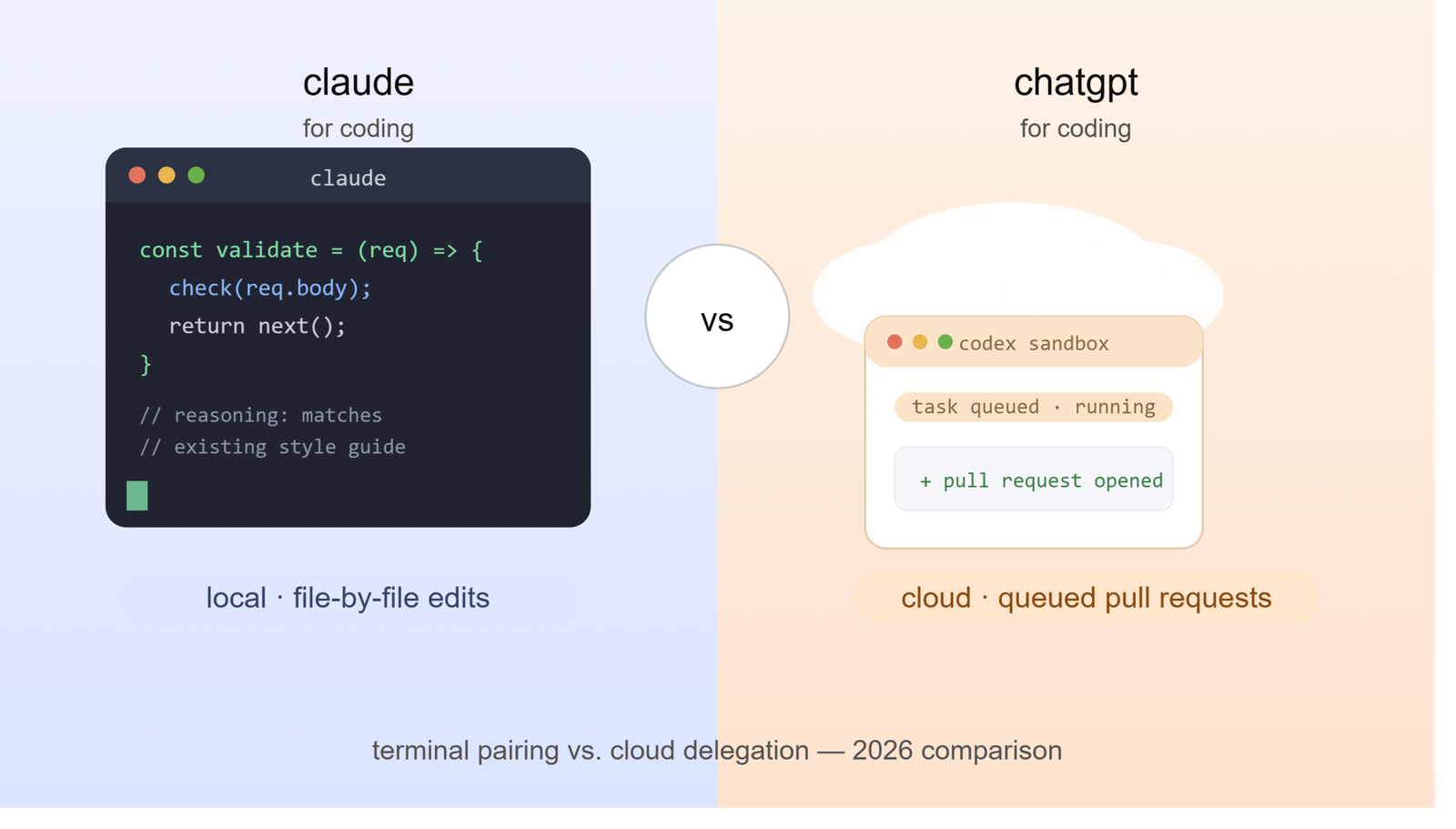
Most of the real debate today is about the third category, because that’s where the tools diverge the most. <cite index=”4-1″>Claude Code lives in your terminal, running with full read and write access to your file system, editing files in real time so you can watch it work, stop it mid-task, and redirect it. The mental model is a pair programmer who reads fast. ChatGPT Codex lives in the cloud: you assign it a task, it spins up a sandbox, clones your repo from GitHub, and returns a pull request when it’s done. The mental model is an intern who works from home and only files complete reports.</cite>
That architectural difference explains almost every other difference in this article. Keep it in mind as you read.
Core Features Compared
Claude’s Strengths
- Deep context handling. Claude tends to hold onto earlier instructions and codebase context more reliably across a long session, which matters when you’re three hours into a refactor.
- Cautious, explainable edits. Claude Code narrates its reasoning and asks before touching risky files, which reduces the “Wait, why did it change that?” moments.
- Strong instruction-following for style guides. If you paste in a coding style guide or architectural constraints, Claude is noticeably better at sticking to them across an entire session rather than drifting after a few turns.
ChatGPT’s Strengths
- Task queuing and parallelism. You can hand Codex five tasks and walk away; it works on them independently and returns pull requests.
- Broader ecosystem integration. <cite index=”5-1″>Codex has surfaces across the ChatGPT web app, the CLI, VS Code, and a macOS desktop app.</cite>
- Multimodal input. ChatGPT handles screenshots, diagrams, and voice input more fluidly, which helps when you’re debugging a UI issue and want to just point at the problem.
- Scheduling and persistence. <cite index=”3-1″>A newer scheduling feature lets Codex plan future work and resume automatically to continue long-term tasks, potentially across days or weeks, combined with memory for cross-session context.</cite>
Neither list is exhaustive, and both companies ship updates monthly. Treat this as a snapshot, not gospel. Always check the current model version before you commit to a workflow built around a specific feature.
How Each Tool Works
Claude Code runs as a CLI you invoke from inside a project directory. It reads your files, proposes changes, and applies them directly to disk. You see differences as they happen. Because it operates locally, it never needs to clone your repo elsewhere; your code stays on your machine, which matters for regulated industries or private IP.
ChatGPT Codex works differently. It clones your repository into an isolated cloud sandbox, runs your task there, and opens a pull request against your branch. You review and merge like you would any teammate’s PR. This is why Codex feels more like delegation and Claude Code feels more like pairing.
Neither approach is objectively better; they solve different problems. Delegation suits well-defined, boundaries-are-clear tasks (write tests for this module, fix this specific bug). Pairing suits ambiguous, exploratory tasks (Why is this service leaking memory, help me redesign this data layer).
Step-by-Step: Testing Both on the Same Task
To make this concrete, here’s how I tested both tools on identical work: refactoring a 40-file Express.js API to add proper input validation.
- Set up the same repo as a local clone and a GitHub-hosted branch, so each tool worked from an identical starting point.
- Wrote one shared prompt describing the validation library, the error format, and which routes to touch.
- Ran Claude Code first, watching it read through the route files, propose a validation schema, and apply changes incrementally while explaining each decision.
- Queued the same task in Codex, then continued other work while it ran in its sandbox.
- Compared the diffs side by side for correctness, consistency, and adherence to the existing code style.
- Ran the test suite against both outputs to check for regressions.
- Reviewed commit messages and PR descriptions for clarity, since that affects how fast a human reviewer can approve the change.
The result: Claude’s output required fewer follow-up corrections to match the existing style, while Codex’s output arrived faster and needed less of my attention during the process. I could keep working elsewhere while it ran.
Claude vs ChatGPT Coding Comparison Table
| Category | Claude / Claude Code | ChatGPT / Codex |
| Architecture | Local terminal agent, direct file access | Cloud sandbox, returns pull requests |
| Best for | Refactors, codebase-aware reasoning, style consistency | Parallel tasks, autonomous grinding, quick fixes |
| Coding benchmark (SWE-bench Verified) | <cite index=”3-1″>Opus 4.8 scores 88.6%</cite> | <cite index=”3-1″>GPT-5.5 scores 88.7%, essentially tied</cite> |
| Entry price | <cite index=”3-1″>Claude Pro: $20/mo</cite> | <cite index=”3-1″>ChatGPT Plus: $20/mo; also an $8/mo Go tier</cite> |
| Top tier | <cite index=”3-1″>Max 20x: $200/mo</cite> | <cite index=”3-1″>Pro $200/mo (20x limits)</cite> |
| Parallel agents | <cite index=”3-1″>No hard cap on Agent Teams, but limits consumed proportionally</cite> | <cite index=”3-1″>Capped at 8 subagents per developer</cite> |
| Code stays local? | Yes, by default | No, repo is cloned to a cloud sandbox |
| Task delegation style | Interactive, real-time collaboration | Fire-and-forget, review later |
| Multimodal input | Improving, text/code-first | Strong (screenshots, voice, diagrams) |
| Developer preference (survey) | <cite index=”5-1″>Code rated cleaner in blind review 67% of the time</cite> | <cite index=”5-1″>Preferred for daily use by 65% of a 500+ developer survey</cite> |
Benchmark scores shift monthly as both companies ship updates; treat any single-point-in-time score as directional, not definitive.
Pros and Cons
Claude Pros
- More consistent adherence to existing code style and architecture
- Transparent reasoning, so you understand why it made a change
- Code stays on your local machine by default
- Strong at large-context, multi-file reasoning
Claude Cons
- Token-based billing on heavier agentic workflows can get expensive fast
- Fewer subscription price points than ChatGPT’s tiered lineup
- Less mature multimodal handling (screenshots, voice) than ChatGPT
- No built-in task scheduling for multi-day autonomous work yet
ChatGPT (Codex) Pros
- Task queuing lets you parallelize work across a sandboxed environment
- Bundled into existing ChatGPT subscriptions, which lowers the barrier for teams already paying for ChatGPT
- Strong multimodal support, useful for UI and visual debugging
- More price tiers, including a budget $8/mo option for light users
ChatGPT (Codex) Cons
- Code must leave your machine to run in the cloud sandbox, a concern for regulated or sensitive codebases
- Subagent workflows are capped, which limits scale for very large parallel jobs
- Reviewing a batch of returned pull requests can feel less collaborative than pair programming.
- Style consistency across a long, ambiguous task can drift more than Claude’s
Pricing Breakdown
Pricing is one of the most frequently searched parts of this comparison, and it’s also the part that changes fastest. Here’s where things stand as of mid-2026:
Anthropic (Claude):
- <cite index=”3-1″>Claude Pro: $20/month</cite>
- <cite index=”3-1″>Claude Max 5x: $100/month</cite>
- <cite index=”3-1″>Claude Max 20x: $200/month</cite>
- Claude Code is included with Pro and Max plans, billed against your plan’s usage limits, with separate API billing available for teams that want pay-as-you-go access.
OpenAI (ChatGPT):
- <cite index=”3-1″>ChatGPT Go: $8/month</cite>
- <cite index=”3-1″>ChatGPT Plus: $20/month</cite>
- <cite index=”3-1″>ChatGPT Pro: $100/month (5x Plus limits, includes the higher-end reasoning model)</cite>
- <cite index=”3-1″>ChatGPT Pro 20x: $200/month</cite>
Practical takeaway: at the entry $20/mo tier, <cite index=”3-1″>ChatGPT Plus still delivers more sessions per dollar than Claude Pro</cite>. But if you’re running heavy agentic refactor work where quality of output matters more than raw session count, the calculus can flip; a cleaner first pass from Claude often means fewer follow-up prompts, which is its own form of cost savings.
Don’t choose a plan based on the sticker price alone. Estimate your actual weekly usage pattern first: how many long agent sessions you run and how many files you touch per task, then match it to a tier.
Best Use Cases for Each
When Claude Is the Better Choice
- Legacy code refactors where architectural consistency matters more than speed
- Security-sensitive projects where you don’t want code leaving your machine
- Debugging deep, non-obvious bugs that require holding a lot of context at once
- Enforcing a strict style guide or internal framework conventions across many files
- Pair-programming sessions where you want to steer the AI in real time
When ChatGPT (Codex) Is the Better Choice
- Well-scoped, independent tasks you can queue and forget—writing tests, fixing a specific bug, updating dependencies
- Teams already paying for ChatGPT who want coding support without a second subscription
- UI and visual debugging where you can drop in a screenshot
- Multi-day background tasks that benefit from scheduling and memory across sessions
- High-parallelism workflows where you’re running several independent tasks at once and reviewing PRs in batch
Who Should Use Which Tool
| Persona | Recommended Tool | Why |
| Solo developer on a legacy codebase | Claude | Better at holding context and matching existing style |
| Startup shipping fast, well-defined tickets | ChatGPT/Codex | Queue tasks, review PRs, keep moving |
| Enterprise team with compliance constraints | Claude | Code stays local; more predictable reasoning |
| The product team already on ChatGPT Enterprise | ChatGPT/Codex | No new vendor, bundled cost |
| Open-source maintainer reviewing many small PRs | ChatGPT/Codex | Batch task delegation fits the PR review workflow |
| Developer doing architecture-heavy refactors | Claude | Long-context reasoning and stability |
If you don’t fit neatly into one row, that’s normal—plenty of teams run both tools side by side and route tasks based on complexity rather than picking one exclusively.
Alternatives Worth Knowing
Claude and ChatGPT aren’t the only players. Depending on your stack, it’s worth evaluating the following:
- Cursor – an AI-native code editor that lets you plug in either Claude or GPT models, useful if you want IDE integration without committing to one vendor’s agent.
- GitHub Copilot – still the most widely adopted inline autocomplete tool, strong for smaller, in-the-moment suggestions rather than full agentic tasks.
- Gemini Code Assist – Google’s coding assistant, competitive for teams already inside the Google Cloud ecosystem.
- Open-source local models (via tools like Continue or Aider) – an option for teams that need everything running on-premises with no external API calls at all.
None of these fully replace the agentic depth of Claude Code or Codex today, but they’re worth testing if vendor lock-in or cost is a bigger concern than raw capability.
Common Mistakes Developers Make
- Judging a tool by one bad session. Both Claude and ChatGPT have off days on ambiguous prompts. Test with at least three or four representative tasks before drawing a conclusion.
- Giving vague prompts and blaming the model. “Fix the bug” produces worse results than “Fix the null pointer exception in UserService.getProfile() when user.email is undefined.” Specificity matters more with agentic tools than with simple autocomplete.
- Ignoring where your code actually runs. Teams under compliance requirements sometimes adopt a cloud-sandbox tool without checking data residency policies first. Always confirm this before rolling out to a regulated codebase.
- Skipping code review because “the AI wrote it.” AI-generated code still needs the same review rigor as human-written code—arguably more, since subtle logic errors can look confidently correct.
- Assuming benchmark scores translate directly to your codebase. SWE-bench and HumanEval measure general coding ability, not how well a tool handles your specific framework, internal libraries, or legacy quirks.
- Not setting usage budgets. Token-based billing on heavy agentic workflows can surprise teams that don’t track usage weekly.
Expert Tips for Getting Better Output
- Give both tools a style guide up front. Paste your linting rules, naming conventions, and architectural patterns before starting a task—both tools follow explicit constraints far better than implicit ones.
- Break large refactors into checkpoints. Instead of “refactor the whole auth module,” ask for one file or one concern at a time, then review before continuing.
- Use Claude for the first pass on ambiguous problems, then Codex for cleanup tasks. This hybrid workflow is common among teams running both tools: Claude explores the solution space, and Codex knocks out the resulting checklist of small fixes.
- Always run your test suite after AI-generated changes, not just a visual diff review. Logic errors often pass a glance but fail a test.
- Version-pin your model choice for critical projects. Since both companies ship frequent model updates, a workflow tuned for one model version can behave differently after an update—document which version you validated against.
Featured Snippet Summary
Claude vs ChatGPT for coding, in one paragraph: Claude, especially through Claude Code, tends to produce more consistent, style-matched code on long, context-heavy refactors and keeps your code on your local machine. ChatGPT’s Codex agent is better for queuing multiple independent tasks in parallel and returning finished pull requests while you work on something else. Coding benchmark scores between the two are close enough to be a coin flip; the real difference is workflow, not raw intelligence.
FAQs
Is Claude better than ChatGPT for coding?
Claude tends to produce cleaner, more style-consistent code on complex, multi-file tasks, while ChatGPT’s Codex agent tends to be faster for well-scoped, independent tasks you can delegate and forget. Neither is universally “better” it depends on the task shape.
Is Claude Code free?
No. Claude Code is bundled into Claude’s paid subscription tiers (Pro and above), and API-based access is billed separately by usage.
What is ChatGPT Codex, and how is it different from ChatGPT?
Codex is OpenAI’s dedicated coding agent, distinct from the general ChatGPT chat interface. It runs coding tasks autonomously in a cloud sandbox and returns pull requests, rather than responding conversationally in a chat window.
Can I use Claude and ChatGPT together for the same project?
Yes, and many experienced developers do exactly this: routing ambiguous, architecture-heavy work to Claude and well-defined, parallelizable tasks to Codex.
Which is cheaper, Claude or ChatGPT, for coding?
<cite index=”3-1″>At the $20/month entry tier, ChatGPT Plus generally provides more sessions per dollar than Claude Pro.</cite> Heavy agentic workflows on either platform can get expensive, so actual cost depends more on usage patterns than the list price.
Does Claude or ChatGPT write more secure code?
Neither tool guarantees secure code by default. Both can introduce vulnerabilities if prompted carelessly or if the reviewer skips a security-focused code review. Treat AI-generated code with the same security scrutiny as any pull request, regardless of which tool wrote it.
Which tool is better for beginners learning to code?
ChatGPT’s broader multimodal support and conversational chat interface tend to be more approachable for beginners asking “Why does this work?” questions. Claude Code’s terminal-first workflow assumes more comfort with the command line.
People Also Ask
- Does Claude Code work offline?
- Is Codex included in ChatGPT Plus?
- What programming languages does Claude support best?
- Can ChatGPT Codex access private GitHub repositories?
- Is Claude Opus better than GPT-5.5 for coding benchmarks?
Final Verdict
There’s no universal winner in the Claude vs ChatGPT for coding debate, and treating it as a single yes-or-no question misses how differently these tools actually work. Claude Code rewards developers who want a careful, transparent collaborator that respects existing code style and keeps everything local. ChatGPT’s Codex rewards developers who want to delegate well-defined tasks and get pull requests back while they focus elsewhere.
If you have to pick one and your work leans toward complex refactors, architecture decisions, or sensitive codebases, start with Claude. If your work leans toward a steady stream of smaller, well-defined tickets you can parallelize, start with ChatGPT’s Codex. If you can afford both, running them side by side and routing tasks by complexity is, in practice, what most experienced teams end up doing anyway.
Key Takeaways
- Claude and ChatGPT are close on raw coding benchmarks; the real difference is workflow architecture, not intelligence.
- Claude Code runs locally and edits files directly; Codex runs in a cloud sandbox and returns pull requests.
- Claude tends to win on style consistency and long-context refactors; Codex tends to win on parallel task throughput.
- Pricing tiers overlap at $20/month, but usage patterns—not list price—determine real cost.
- Many experienced teams use both tools, routing tasks by complexity rather than picking one exclusively.
- Always review AI-generated code with the same rigor as human-written code, regardless of which tool produced it.
Conclusion
Choosing between Claude and ChatGPT for coding comes down to matching the tool’s architecture to your actual workflow, not chasing a single benchmark number. Test both on a real task from your own codebase—not a toy example—before committing a team workflow to either one. The gap between them is narrow enough that your specific project, security requirements, and budget will matter more than which company shipped the higher SWE-bench score this quarter.
Ready to decide? Run the same real task through both tools this week, compare the differences side by side, and let your own codebase—not a marketing page—make the call.
Related Guide: ChatGPT vs Claude: Which AI Assistant Actually Wins in 2026?