

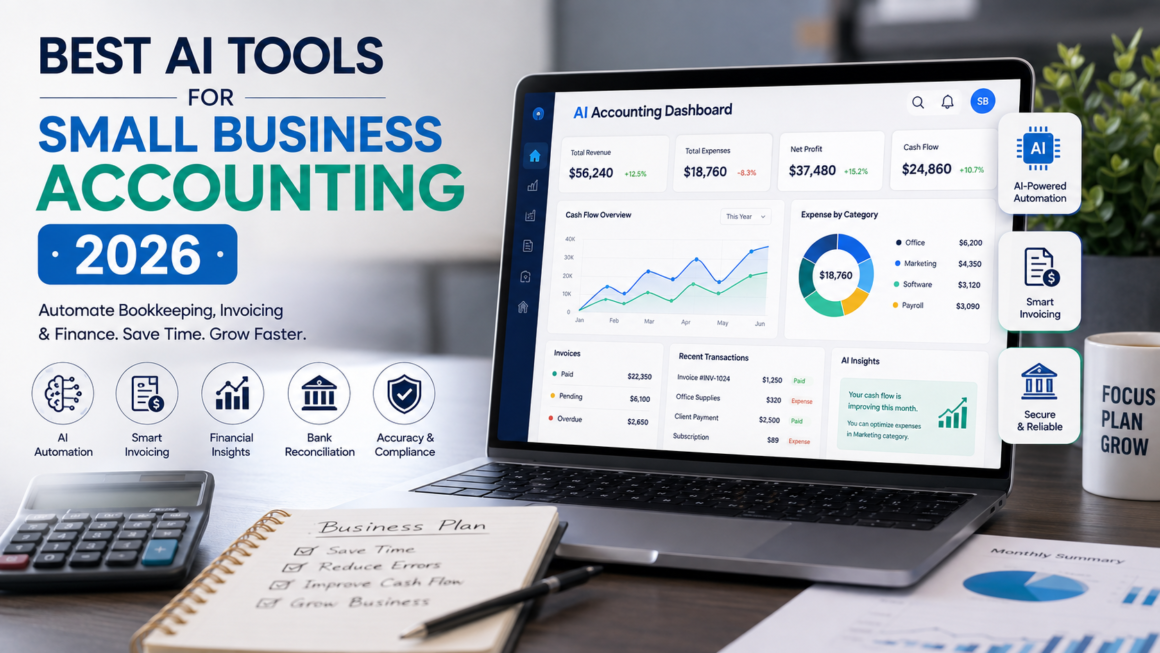
Running a small business means wearing multiple hats. Accounting often becomes one of the most time-consuming responsibilities, especially when managing invoices, expenses, payroll, taxes, and financial reports.
The Best AI Tools for Small Business Accounting 2026 help automate repetitive financial tasks, reduce manual errors, and provide real-time insights that improve business decisions. Instead of spending hours on bookkeeping, business owners can focus on growth while AI handles much of the financial administration.
Whether you’re a freelancer, startup, e-commerce seller, agency owner, or local business, modern AI accounting software can significantly improve productivity while keeping your finances organized.
If you’re also exploring broader business automation, check out Best AI Automation Tools for Small Businesses 2026 and Best AI Tools for Small Businesses 2026 to discover additional AI solutions that streamline marketing, operations, customer service, and productivity.
Quick Answer
The Best AI Tools for Small Business Accounting 2026 include:
- QuickBooks Online
- Xero
- FreshBooks
- Zoho Books
- Sage Accounting
- Wave
- Vic.ai
- Dext
- Expensify
- BILL
- Puzzle
- Zeni
- Botkeeper
- FloQast
- Docyt
These tools automate bookkeeping, invoice processing, expense categorization, bank reconciliation, financial reporting, and cash flow forecasting using artificial intelligence.
What Are AI Accounting Tools?
AI accounting software combines traditional accounting functions with machine learning, automation, and predictive analytics.
Instead of simply recording transactions, these platforms can:
- Categorize expenses automatically
- Match bank transactions
- Detect duplicate payments
- Predict future cash flow
- Scan receipts
- Create invoices
- Flag unusual spending
- Prepare financial reports
- Automate recurring bookkeeping tasks
The result is faster accounting with fewer manual mistakes.
Why Small Businesses Are Adopting AI Accounting Software
Traditional bookkeeping requires constant manual work.
AI dramatically reduces repetitive tasks while improving financial visibility.
Businesses benefit from:
- Faster month-end closing
- Better cash flow management
- Lower bookkeeping costs
- More accurate reports
- Reduced human error
- Improved tax preparation
- Real-time financial dashboards
- Better business forecasting
For growing companies, these advantages often translate into better financial decision-making.
Key Features to Look For
Before choosing any AI accounting software, evaluate these capabilities.
Automated Bookkeeping
AI automatically classifies income and expenses based on transaction history.
Smart Invoice Processing
Invoices are scanned, categorized, and entered into accounting records automatically.
AI Expense Management
Receipt scanning and expense categorization reduce manual entry.
Bank Reconciliation
Transactions are automatically matched with bank statements.
Financial Forecasting
AI predicts future revenue, expenses, and cash flow trends.
Tax Preparation
Many platforms organize deductible expenses and generate tax-ready reports.
Payroll Integration
Some tools connect directly with payroll providers for seamless financial management.
How AI Accounting Software Works
Most AI accounting platforms follow a similar workflow.
Step 1
Connect bank accounts and payment processors.
Step 2
Import transactions automatically.
Step 3
AI categorizes income and expenses.
Step 4
The software reconciles accounts.
Step 5
Dashboards update in real time.
Step 6
Reports are generated instantly.
Step 7
Business owners receive financial insights and recommendations.
Best AI Tools for Small Business Accounting 2026
1. QuickBooks Online
Best for: Small businesses of every size
Key Features
- AI transaction categorization
- Automated bookkeeping
- Smart invoicing
- Payroll integration
- Cash flow forecasting
- Tax reporting
Pros
- Industry-leading ecosystem
- Excellent reporting
- Strong integrations
Cons
- Higher pricing than some competitors
2. Xero
Best for: Growing companies
Highlights include:
- AI bank reconciliation
- Automated invoices
- Multi-currency support
- Inventory management
- Financial dashboards
3. FreshBooks
Ideal for freelancers and service businesses.
Strengths:
- Easy invoicing
- Expense tracking
- Time tracking
- Automated payment reminders
4. Zoho Books
Excellent for businesses already using the Zoho ecosystem.
Features include:
- AI-powered workflows
- Invoice automation
- Inventory
- Tax compliance
- Client portal
5. Sage Accounting
Designed for businesses needing strong financial reporting.
Key capabilities:
- Cash flow monitoring
- Smart reconciliation
- AI expense tracking
- Financial forecasting
6. Wave
A strong option for startups seeking affordable accounting.
Features include:
- Free accounting
- Receipt scanning
- Invoice creation
- Payment processing
7. Vic.ai
Purpose-built for accounts payable automation.
AI automates:
- Invoice approvals
- Data extraction
- Vendor management
- Payment workflows
8. Dext
Previously known for receipt management, Dext has become one of the leading AI bookkeeping tools.
It automatically extracts information from:
- Receipts
- Bills
- Bank statements
- Supplier invoices
9. Expensify
Ideal for employee expense management.
AI helps:
- Scan receipts
- Approve expenses
- Reimburse employees
- Track spending
10. BILL
Formerly Bill.com, BILL focuses on payment automation.
Best features:
- Accounts payable
- Accounts receivable
- Approval workflows
- Vendor payments
11. Puzzle
A newer AI-first accounting platform designed specifically for startups.
Highlights include:
- Real-time accounting
- AI reconciliation
- Automated reporting
12. Zeni
Offers AI bookkeeping combined with human financial experts.
Ideal for startups needing CFO-level insights.
13. Botkeeper
An outsourced bookkeeping platform powered by AI.
Great for businesses wanting less manual accounting work.
14. FloQast
Popular among finance teams needing faster month-end close.
15. Docyt
Best for businesses with multiple locations.
Its AI automates:
- Daily bookkeeping
- Revenue recognition
- Financial reporting
Benefits of AI Accounting Software
Using the Best AI Tools for Small Business Accounting 2026 offers measurable advantages.
- Saves hours every week
- Reduces bookkeeping errors
- Improves cash flow visibility
- Simplifies tax preparation
- Speeds up invoice processing
- Generates financial reports instantly
- Helps detect fraud and unusual transactions
- Supports smarter business decisions
Pros
- Significant time savings
- Better financial accuracy
- Automated reporting
- Easy integrations
- Improved forecasting
- Reduced manual work
Cons
- Monthly subscription costs
- Learning curve for new users
- AI still requires human oversight
- Some advanced features cost extra
- Sensitive financial data requires strong security practices
Pricing Comparison
| Tool | Pricing Model |
| QuickBooks | Subscription |
| Xero | Subscription |
| FreshBooks | Subscription |
| Zoho Books | Subscription |
| Wave | Free + Premium |
| BILL | Subscription |
| Dext | Subscription |
| Expensify | Subscription |
| Puzzle | Custom |
| Zeni | Custom |
Best Use Cases
Different businesses have different accounting needs.
Freelancers
- FreshBooks
- Wave
E-commerce Stores
- QuickBooks
- Xero
Agencies
- Zoho Books
- Sage
Startups
- Puzzle
- Zeni
Businesses with Large Expense Volumes
- Expensify
- Dext
Companies Managing Vendor Payments
- BILL
- Vic.ai
Who Should Use the Best AI Tools for Small Business Accounting 2026?
These tools are ideal for:
- Small business owners
- Freelancers
- Consultants
- Agencies
- Ecommerce businesses
- Local service companies
- Startups
- Nonprofits
- Online sellers
If bookkeeping consumes valuable time every month, AI accounting software can provide immediate productivity gains.
Alternatives
Some businesses may prefer combining multiple specialized solutions instead of an all-in-one platform.
Popular alternatives include:
- Spreadsheet automation
- Traditional bookkeeping firms
- ERP systems
- Human accountants with AI-assisted workflows
The right choice depends on business size, transaction volume, compliance requirements, and budget.
Common Mistakes
Many businesses fail to maximize AI accounting software because they overlook basic setup.
Avoid these mistakes:
- Choosing software without checking integrations
- Ignoring bank reconciliation rules
- Failing to review AI-generated categories
- Not backing up financial records
- Delaying software updates
- Giving unnecessary user permissions
- Assuming AI never makes mistakes
Human oversight remains essential for accurate financial reporting.
Expert Tips
- Connect all financial accounts from the beginning.
- Review automated categorizations during the first few months.
- Build approval workflows for large expenses.
- Schedule monthly financial reviews.
- Use dashboards to monitor cash flow weekly.
- Integrate accounting with payroll and CRM systems.
- Automate recurring invoices whenever possible.
- Train your team on AI-assisted workflows.
Summary Box
Best Overall: QuickBooks Online
Best Budget Option: Wave
Best for Startups: Puzzle
Best for Agencies: Zoho Books
Best for Expense Management: Expensify
Best AI Bookkeeping Tool: Dext
Best Accounts Payable Automation: Vic.ai
Best Financial Insights: Zeni
Key Takeaways
- The Best AI Tools for Small Business Accounting 2026 automate bookkeeping, invoicing, and reporting.
- AI reduces manual data entry and improves financial accuracy.
- Different platforms excel in different areas, from expense management to accounts payable automation.
- Businesses should prioritize integrations, security, and scalability when selecting software.
- AI works best when combined with periodic human review.
People Also Ask
What is the best AI accounting software for small businesses?
QuickBooks Online, Xero, and Zoho Books are among the most complete solutions because they combine bookkeeping, invoicing, reporting, and automation.
Can AI replace a bookkeeper?
AI can automate repetitive bookkeeping tasks, but human expertise is still important for tax planning, financial strategy, and compliance.
Which AI bookkeeping tools are best for startups?
Puzzle, Zeni, QuickBooks Online, and Dext are excellent options for startups seeking automation and financial visibility.
What is the best AI invoicing software?
FreshBooks, Zoho Books, and QuickBooks offer advanced invoice automation, recurring billing, and payment tracking.
Are AI finance tools for small business secure?
Most leading providers use encryption, multi-factor authentication, and compliance standards to protect financial data. Businesses should still follow strong access controls and regular security reviews.
FAQs
Is AI accounting software worth it?
Yes. Businesses with recurring bookkeeping tasks typically save significant time while reducing manual errors.
Can AI help during tax season?
Yes. AI organizes transactions, categorizes expenses, and generates tax-ready reports, making preparation much easier.
Does AI work with existing accounting systems?
Most leading platforms integrate with banks, payment processors, payroll systems, ecommerce platforms, and CRM software.
Which solution is best for freelancers?
FreshBooks and Wave remain popular choices because they combine ease of use with affordable pricing.
Should every small business adopt AI accounting?
Businesses handling frequent invoices, expenses, or payroll usually benefit the most. Very small operations with minimal transactions may not require advanced automation immediately.
Final Verdict
The Best AI Tools for Small Business Accounting 2026 are no longer just productivity tools—they have become strategic business assets. Whether you need automated bookkeeping, intelligent invoice management, expense tracking, or financial forecasting, today’s AI-powered platforms can reduce administrative work while improving financial accuracy.
QuickBooks Online remains the strongest all-around choice for most businesses, while Xero and Zoho Books offer excellent flexibility for growing organizations. Startups may prefer Puzzle or Zeni for AI-first workflows, and businesses with heavy expense or accounts payable processes can benefit from Dext, Expensify, BILL, or Vic.ai.
Choose software based on your transaction volume, integrations, reporting needs, and long-term growth plans rather than price alone.
Conclusion
Selecting the Best AI Tools for Small Business Accounting 2026 depends on your business goals, existing software stack, and accounting complexity. The right platform can automate repetitive work, improve financial visibility, and free your team to focus on growth instead of paperwork.
Start by identifying your biggest accounting bottlenecks, compare the features that matter most, and test a platform with a free trial whenever possible. Investing in modern AI accounting software, AI bookkeeping tools, AI invoicing software, and AI finance tools for small business today can create long-term efficiency, better decision-making, and a healthier financial foundation for the future.