


Search is evolving at a rapid pace.
Traditional search results aren’t the only ones relied upon. In the present day, users directly ask questions to AI-powered platforms like ChatGPT, Gemini, Claude, Perplexity, and Google AI Overviews. These platforms produce complete answers as opposed to a list of links.
As a result, website owners, marketers, and content creators are facing a new challenge.
Even if your pages rank well in traditional search results, you might experience a drop in visibility if your content is not understood, trusted, or cited by AI systems.
That’s where generative engine optimization strategies are important.
Generative Engine Optimization (GEO) is a technique that supports businesses in optimizing their content for AI-powered search results. It boosts the likelihood of AI platforms finding, comprehending, referencing, and quoting your content in their answers.
This guide will cover the basics of GEO, how it differs from SEO, and the best practices for optimizing your presence on AI search engines.
What is Generative Engine Optimization (GEO)?
Generative Engine Optimization (GEO) involves optimizing your content in a way that AI search engines can find, comprehend, summarize, and quote it in their generated responses.
The traditional SEO approach is on to the web pages appearing on the search engine results pages (SERPs).
GEO aims to get content embedded within the answers produced by AI.
Generative Engine Optimization Definition
If you can’t find a more precise one, then a simple definition is:
Generative Engine Optimization involves optimizing content for quality, structure, authority, and relevance to ensure that AI systems can consider it a reliable source for creating answers.
The objective is not only to get a higher ranking but also to be a source cited.
Why GEO is important in modern search
The use of AI-powered search platforms is growing to be a key source of information.
The users ask the following question now:
- Which is the best AI writing tool?
- How does GEO work?
- What’s the new SEO?
They don’t have to click on multiple websites, but rather are sent a direct answer.
When your content is a part of that answer, your brand becomes visible, trusted, and authoritative.
How AI Search Engines Use Content
The general idea of most AI search systems is to perform the following three basic steps:
Retrieval
The system looks for the content that is relevant.
Understanding
The AI records the information and extracts important facts.
Generation
The platform develops an abridged response and can refer to reputable sources.
Clear, accurate and structured content is more likely to be selected.
GEO vs Traditional SEO
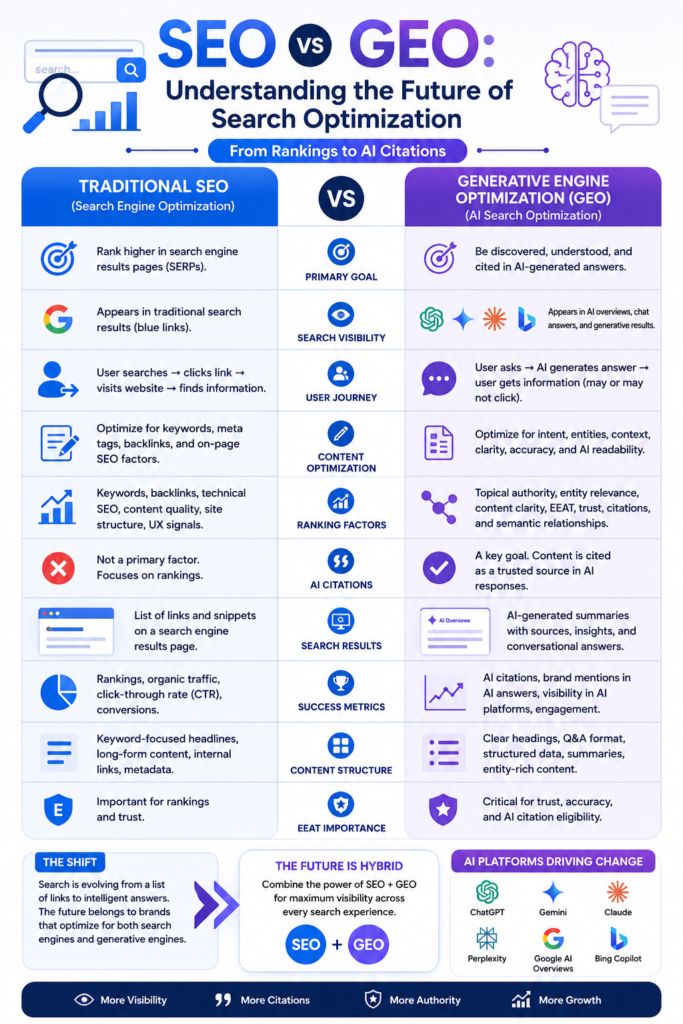
Many marketers wonder whether GEO will replace SEO.
The answer is no.
Both strategies work together.
Key Differences Between GEO and SEO
| SEO | GEO |
| Focuses on search rankings | Focuses on AI-generated answers |
| Targets SERPs | Targets AI responses |
| Measures ranking positions | Measures citations and visibility |
| Optimizes for search algorithms | Optimizes for AI retrieval systems |
Similarities Between GEO and SEO
Both require:
- High-quality content
- User-focused information
- Technical optimization
- Authority and trust signals
- Strong site structure
Why Businesses Need Both
SEO helps users find your website.
GEO helps AI systems trust and reference your content.
Brands that combine both approaches can maximize visibility across traditional and AI-powered search experiences.
To understand how Generative AI Search Engines function.To grasp the operation of Generative AI Search Engines.
How Generative AI Search Engines function
Knowing about AI Search platforms can aid you in developing better content.
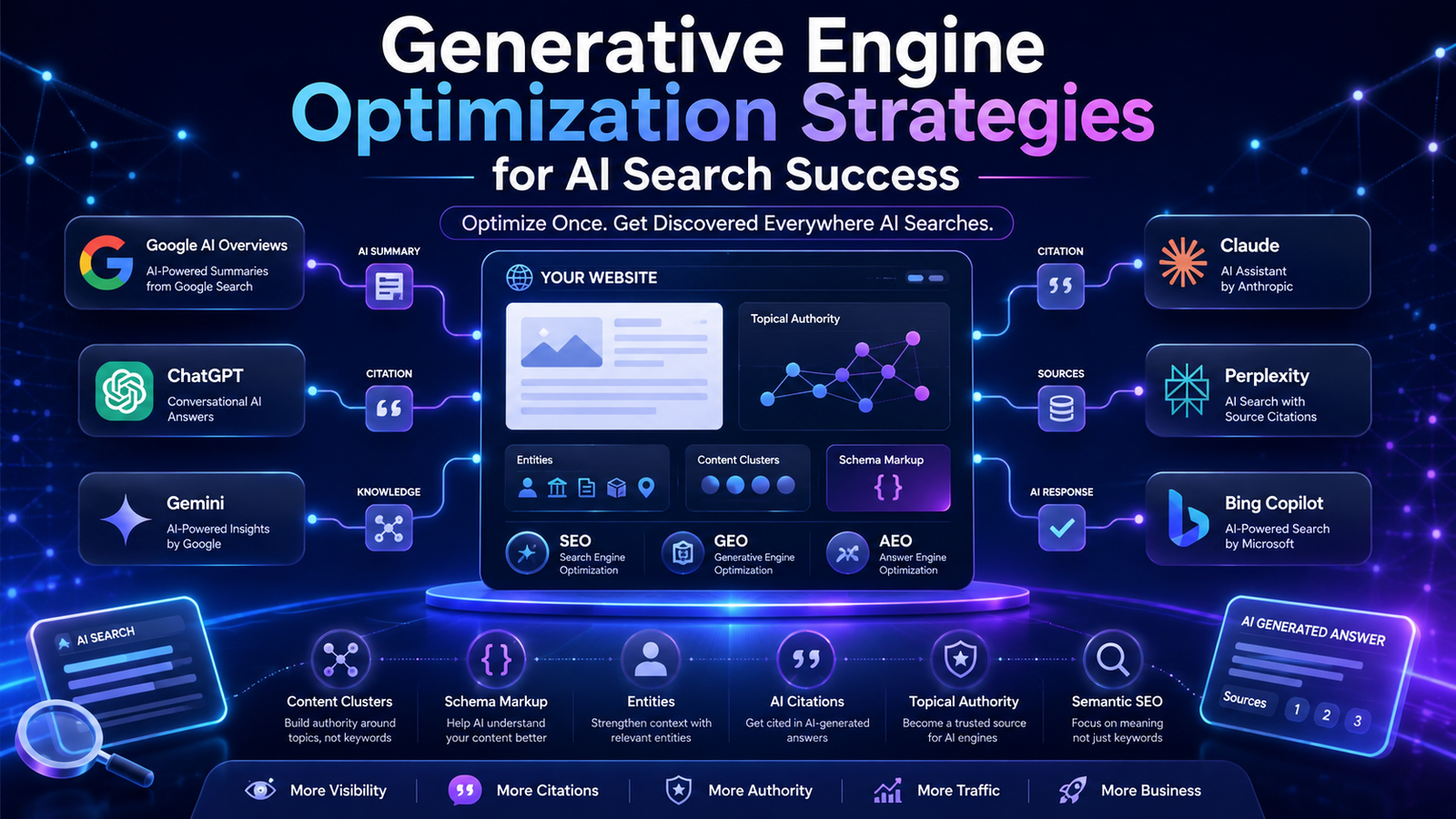
Google AI Overviews
Google AI Overviews provide you with summaries in search results.
The system fetches data from several trusted sources, and gives a short answer.
These summaries are more likely to include content which showcases expertise and authority.
ChatGPT
As of now, ChatGPT is increasingly using information from the web to answer queries.
Enjoys well-structured, factual and easy-to-understand content.
Gemini
The Google AI integration of Gemini brings generative AI to the search functionality.
The results from the content that abides by semantic SEO and topical authority are more successful when using Gemini powered answers.
Claude
Claude’s strengths are clarity, safety and context understanding.
Claude tends to master well-structured information in its responses.
Perplexity
Sources are often mentioned in Perplexity.
This makes it one of the most essential in terms of platform for GEO optimization.
Bing Copilot
Microsoft’s AI-powered search experience is powered by sophisticated retrieval techniques that produce answers.
Credibility is an important factor in visibility.
Top Generative Engine Optimization Strategies
Now that we’ve talked about the strategies you can use to boost your presence on AI search platforms, here are some useful tips to help you further along the journey.Let’s now delve deeper into the strategies that can help you enhance your visibility on AI search platforms.
Create Entity-Rich Content
Entities are objects such as people, organisations, locations, products and concepts that AI systems recognize and comprehend.
If, for instance, you’re writing a content about GEO, include other corresponding entities like:
- Google AI Overviews
- ChatGPT
- Gemini
- Perplexity
- Schema Markup
- Semantic SEO
Rich content with entities aids in the accurate contextual understanding of the text by AI.
Build Topical Authority
AI systems like websites that show an understanding of a topic generally.
Don’t post one article about GEO – make supporting material including:
- GEO checklist
- GEO vs SEO
- AI search optimization
- AI Overview optimization
- Semantic SEO guide
This Topic Cluster way enhances the authority.
Use Clear Question-and-Answer Formats
When using AI systems, it is common to find content that directly answers users’ questions.
Example:
Generative Engine Optimization (GEO): What is it?
Generative Engine Optimization involves optimizing content to be found, understood, and cited by the AI-powered search engine in generated answers.
This style will help improve the featured snippets and AI responses.
Optimize for AI Citations
AI platforms like these look for content with the following elements:
- Clear definitions
- Original insights
- Verified facts
- Supporting evidence
- Expert opinions
Make all the article citations.
Improve Content Accuracy
Mistakes lead to loss of confidence.
Regularly check and refresh inaccurate information.
The more accurate the content, the more likely that it will get cited by AI.
Add Expert Insights
Content that is not specific to the particular product is easily ignored.
Content is more valuable if it is unique.
Include:
- Personal experiences
- Industry observations
- Original opinions
- Practical recommendations
They are elements that will make your content stand out from the rest.
Use Structured Data
Schema markup is used to enable search engines to better understand content.
These are some of the important types of schema:
- Article Schema
- FAQ Schema
- Organization Schema
- Author Schema
Content Discovery is enhanced with structured data.
Improve EEAT Signals
The importance of Experience, Expertise, Authoritativeness, and Trustworthiness are still significant.
Strengthen EEAT by:
- Adding author bios
- Citing credible sources
- Publishing accurate information
- Displaying business credentials
Both users and AI systems can benefit from strong EEAT signals, as this helps build trust in the user and the AI itself.
How to Optimize Content for AI Search Engines
While creating valuable content is vital, it’s also just one aspect of GEO. Additionally, content needs to be formatted in a manner easily accessible for AI to understand and retrieve.
Write Direct Answers First
To append the answer, many AI platforms will first check for a short answer in the rest of content.
Introducing a topic, state an answer within the first few sentences.
For example:
What are generative engine optimization strategies?
Generative engine optimization strategies are methods that optimize content for AI-powered search engines for increased visibility, clarity, authority, and relevance.
This could be useful for users and AI systems to locate information in a quick manner.
Use Semantic Keywords Naturally
Common AI systems today are able to grasp the connections between subjects.
Do not use the same keyword too many times in the article, but use synonyms to the keyword throughout the article naturally.
Examples include:
- AI search optimization
- AI citations
- answer engine optimization
- semantic SEO
- Google AI Overviews
- content authority
Semantic relevance assists AI in comprehending the overall meaning of your material.
Structure Content Logically
Using a logical structure makes it easier to read and retrieve.
Use:
- Clear headings
- Descriptive subheadings
- Bullet points
- Tables where appropriate
- FAQ sections
The article is clearly structured, making it easy for AI systems to extract critical content.
Improve Readability
Easily digestible material is more effective for human and AI readers.
Best practices include:
- Short paragraphs
- Simple language
- Active voice
- Clear transitions
- Consistent formatting
AI systems can typically process content better if readers are able to understand it easily.
Add Supporting Data and Examples
Facts strengthen credibility.
Include:
- Industry statistics
- Research findings
- Expert insights
- Real-world examples
- Case studies
Evidence that supports enhances trust and likelihood of being cited.
Common GEO Mistakes to Avoid
There are many websites that do not get good visibility for their AI due to the lack of consideration of essential optimization factors.
Publishing Thin Content
AI sources that are short articles with little value, do not become trusted.
Discuss the subject extensively and provide answers to questions related to the topic in the same article.
Ignoring Entities
AI systems can have difficulties grasping the context without entities.
Include relevant technologies, platforms, organizations and concepts throughout the content naturally.
Weak Topical Coverage
Authorities can’t be build around a single article.
Develop topic clusters.
For GEO supporting articles may be:
- GEO tools
- GEO checklist
- AI Overview optimization
- GEO case studies
Comparing Geo and SEO can be a little confusing.
Missing Trust Signals
The content is more likely to seem untrustworthy if it is anonymous.
Include:
- Author information
- Business details
- Source references
- Contact information
Both EEAT and GEO goals can be met through the use of trust signals.
Poor Content Structure
Avoid using too many large blocks of text.
Chunk content into shorter, more scannable and comprehensible chunks.
GEO Best Practices for 2026 and Beyond
AI search is a continually evolving technology. However, there are some practices which are likely to be important.
Focus on AI Citation Readiness
AI systems love content which can be referred to with confidence.
To make the students more equipped to write citations:
- Define concepts clearly
- Verify facts
- Include unique insights
- Update content regularly
Optimize for Knowledge Graph Connections
Knowledge graph enables the search engines to grasp the connections between entities.
Link your material to well-known people, events, and places with the correct details and context.
Create brand entity authority
Brands are increasingly being identified as a brand itself within AI systems.
To beef up your brand by:
- Publishing consistent content
- Being mentioned by the likes of the Guardian is a great honor
- Building topical authority
- Having a solid online brand presence is vital to your business
Create Multi-Platform Visibility
Avoid putting all your eggs into one basket (specifically search engine).
Optimize for:
- Google AI Overviews
- ChatGPT
- Gemini
- Claude
- Perplexity
- Bing Copilot
Having a variety of visibility strategies means you’re not relying on one source of traffic to drive your business.
Real-World GEO Implementation Checklist
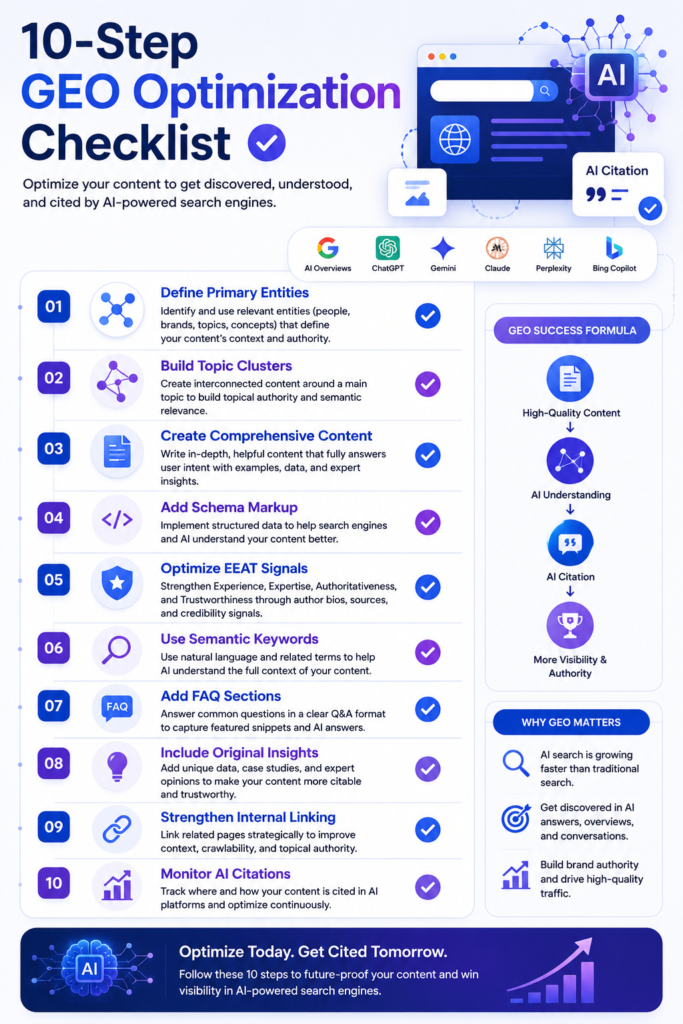
This is the checklist you can use when optimizing existing content.
Content Quality
✓ Respond to the intent of the user clearly
✓ Provide complete information
✓ Add practical examples
✓ Include unique insights
Entity Optimization
✓ Mention relevant entities
✓ Build semantic connections
✓ Improve contextual relevance
Technical Optimization
✓ Add schema markup
✓ Improve page speed
✓ Ensure mobile friendliness
✓ Use descriptive URLs
Topical Authority
✓ Create supporting articles
✓ Build content clusters
✓ Strengthen internal links
✓ Cover related subtopics
EEAT Verification
✓ Display author credentials
✓ Add trusted references
✓ Update content regularly
✓ Demonstrate expertise
Using this checklist can help you to be more likely to get your answers from an AI.
Frequently Asked Questions
What is generative engine optimization?
The process of optimising content for the purposes of discovery, understanding, summarising, and citing by AI-powered search engines is known as Generative Engine Optimization (GEO).
What is the difference between GEO and SEO?
SEO targets the rankings on the search engine results page, GEO targets the visibility within answers and summaries generated by AI.
Why are generative engine optimization strategies important?
These strategies will allow companies to stay relevant as users are increasingly turning to AI-driven search experiences instead of search results.
Can GEO help with Google AI Overviews visibility?
Yes. Content that is well-structured, authoritative, and factual stands a better chance of being referenced in Google AI Overviews.
What are the criteria AI search engines use to determine content sources?
Relevance, authority, accuracy, structure and trust signals are typical metrics used by AI systems to assess content for inclusion in generated answers.
Does schema markup benefit GEO?
Yes. Schema Markup adds context to improve search engine and AI understanding of content.
Is GEO replacing SEO?
No. GEO is not an alternative to SEO, it’s a complement. For maximum visibility, it is necessary to include both strategies.
What are the steps for businesses to take to implement GEO?
Begin by building a solid content foundation, building topical authority and leveraging structured data, enhancing EEAT, and optimizing content for AI retrieval and citations.
Key Takeaways
- Generative Engine Optimization can be used to get content to show up in AI-generated answers.
- GEO specializes in being visible in platforms like ChatGPT, Gemini, Claude, Perplexity, and Google AI Overviews.
- SEO and GEO are best suited together.
- Entity optimization enhances context-awareness.
- Having a topical structure boosts trust and visibility.
- Structured content allows AI to easily find information.
- EEAT is still one of the most important ranking and citing signals.
- Citation value is enhanced by original insights and factual accuracy.
- Schema Markup boosts content visibility.
- Early adoption of GEO could give businesses a competitive edge.
Conclusion
AI-powered search is revolutionizing online information.
Users are increasingly turning to answers created rather than more than one search result. Therefore, businesses need to diversify their optimization methods from conventional SEO.
Generative engine optimization strategies help content become more discoverable, understandable, and citable across modern AI search platforms. By creating authoritative content, building topical authority, improving EEAT signals, and optimizing for AI retrieval systems, businesses can increase their visibility in the next generation of search.
The best brands will not opt for either SEO or GEO. They will use both methods to compose content that will rank well in search engines and will be effective in AI-generated responses.
With AI search on the horizon, investing in GEO now will benefit organizations to gain trust, citations, and visibility in the future.
👉 For more technology insights and AI transformation strategies, explore expert content on ByteBenz.