

For most companies, the concept of AI transformation is rooted in the notion of acquiring the appropriate tools. They spend money on machine learning platforms, on data scientists, and on pilot programs. Then they ask themselves, ‘Why doesn’t anything scale?’ Then they ask themselves, ‘Why doesn’t anything scale?
They usually have nothing to do with the technology.
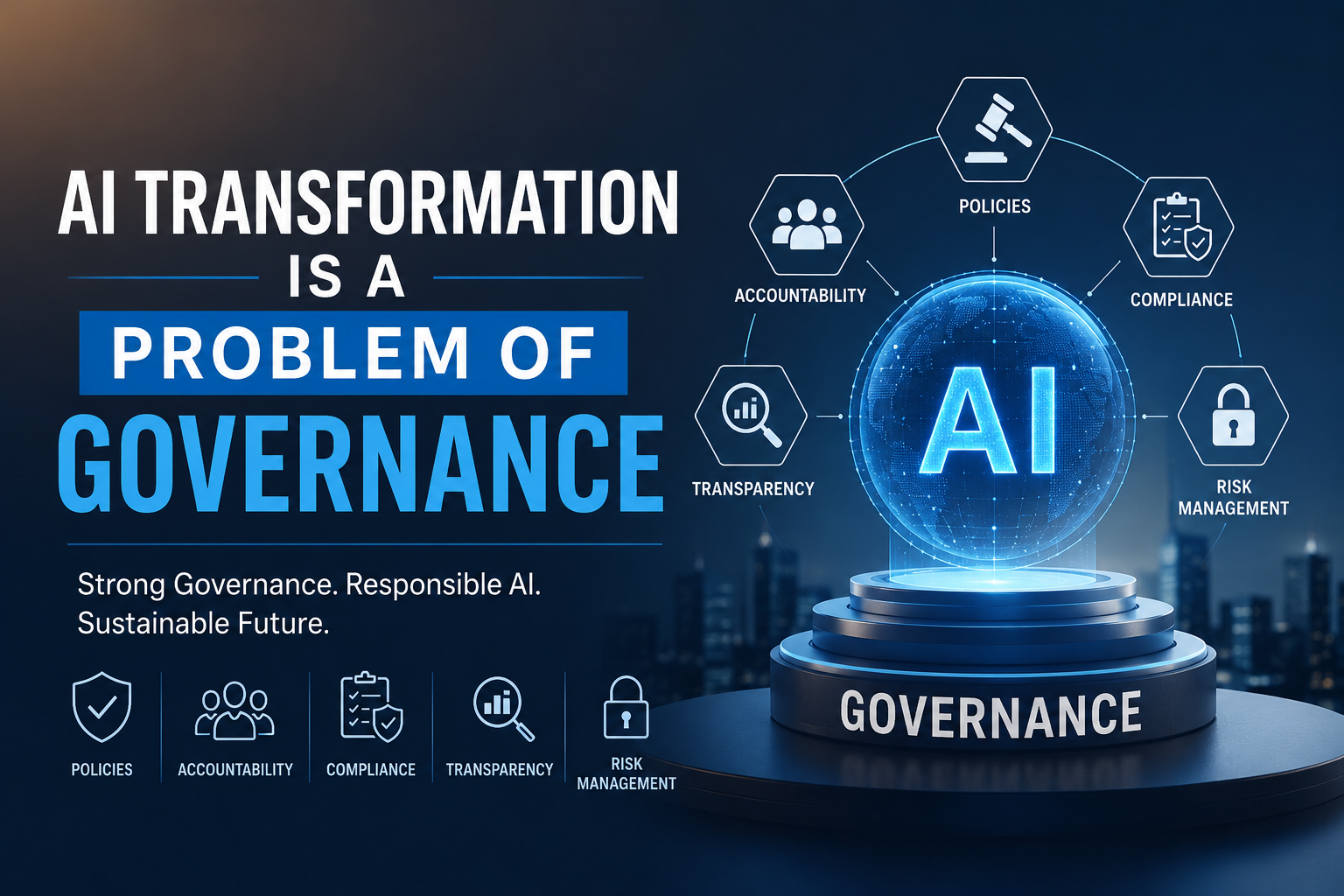
AI transformation is a problem of governance. It’s about making decisions together, holding each other accountable, addressing risk together, and bringing leadership together around a shared strategy. Any good AI tool without it wouldn’t work.
What Does AI Transformation Really Mean?
AI transformation is more than just about using AI. It’s a matter of restoring the method a business performs with wise, info-driven systems.
It is easy to tell that a company is using AI tools, versus one that is truly AI-powered. If you are using ChatGPT to generate copy ideas for your marketing team, you are employing AI.Using ChatGPT for copy ideas is an instance of AI. A financial services company that automates the risk decisions, compliance checks, and customer workflows with connected AI systems: AI transformation.
The change in shift has everything change. Workflows change. Teams change. Roles shift. Leadership is required to see things differently, regarding strategy and accountability.
But, rather, companies such as Google, JPMorgan, and Microsoft have purchased AI tools. They reorganized, retrained people and established policies for the involvement of AI in all aspects of the business.
That’s how AI transformation should look like. This does not represent a technology improvement. It’s an organisational one.
Why Technology Alone Cannot Solve AI Challenges
Organizations are drawn into things right away and think of implementing. They select a platform, they start model building, they get live – without any harder questions about purpose, ownership and risk, they take it down this path.
It is here that it all goes wrong.
Lack of Strategic Direction
Many businesses are already leveraging AI but without a specific business goal. Teams build models out of solving problems not stated. AI projects that are not strategically planned fail to sustain and momentum is fast lost.
Transformation requires direction. A real business problem with measurable business impact must be addressed by the AI.
Data Governance Problems
AI is unreliable if the data isn’t of good quality. The quality of data that are fed into a model is the quality of the model. AI is only misleading, not informing, when data is isolated, fragmented and not current.
This is a lesson learned by numerous organisations when they scale up their AI efforts. Very costly and labor intensive to make post-hoc data infrastructure changes.
Compliance and Legal Risks
Tangible restrictions on the application of AI are being set by guidelines like GDPR, CCPA and EU AI Act.The introduction of privacy laws like GDPR, CCPA and EU AI Act is restricting the use of AI. The pressures on regulation are building up quickly and the consequences of not conforming are severe – financial and reputational.
Without the compliance frameworks, businesses can be taking on risks they are not aware of when creating AI.
Human Resistance and Organizational Silos
Fears that AI will steal jobs are a concern among employees. Often the leadership teams don’t share the same vision in the larger business context when it comes to AI. Data is not shared among departments, neither in the same department nor with other departments.
None of this is a technology problem. It is a people and structure problem. That is exactly why AI transformation is a problem of governance, not a problem of software.
AI Governance: The Missing Foundation
AI governance is the collection of policies, accountability and oversight framework for the development and utilization of AI in an organization. Without it, AI transformation does not progress or becomes more complicated than the problems that it is trying to solve.
Governance is the driving force behind the trustworthiness, scalability and sustainability of AI.
Policy Creation
AI should have a set of guidelines on how to be used within the organization. This includes policy on ethical use of AI, acceptable use policy and guidelines on what AI can decide – and cannot.
When no rules are written, make up a set of rules for each team. This results in inconsistencies, risks and confusions.
Accountability
Who’s in charge of an AI decision in your organization? Who is liable in case the wrong output is generated by an AI system?
Ownership assignment is clearly made by Governance. This may be a responsibility assignment such as that of a Chief AI Officer, a product team, or a cross-functional committee—but who must be held accountable needs to be clear. One of the leading issues to cause the failure of AI initiatives is ownership concerns.
Risk Management
There are a number of risks that can be raised with AI systems, including training data bias, security risks, and regulatory considerations. All three are under a framework of governance.
To prevent bias, regular model audits are needed. Security monitoring is able to find something that is not an incident. Regular check-ups for regulatory compliance aid in guaranteeing that AI practices are compliant with evolving regulations.
Transparency
Explainable AI matters. It is important that stakeholders—such as customers, regulators or employees—can understand the rationale behind decisions made by the system.
The companies will be able to view the results and make necessary adjustments due to decision traceability. Featuring transparency is a key ingredient to building trust in AI.
The Biggest Governance Challenges in AI Transformation
Leadership Misalignment
Without executive buy-in, no action will take place. To transform with AI, you must have leadership from the top. Otherwise teams start to go in different directions and resources are wasted.
Lack of AI Ethics Frameworks
There are no established ethics policy for AI in many companies. This leads to blind spots, especially for issues of bias, fairness and the handling of sensitive information.
Weak Data Infrastructure
Governance is not possible without reliable data about the world. Inadequate data pipelines, lack of standardization in data labels, and scattered data storage make it impossible to audit the AI systems or believe their results.
Unclear Ownership of AI Systems
The absence of an owner means the absence of maintenance for an AI system. Models drift, data change and performance decreases sometimes without anyone being aware of it until it breaks.
Rapidly Changing Regulations
There is a rapidly evolving regulatory environment. European, American and Asian governments are implementing rules for artificial intelligence. Those not keeping an eye on this will be taken aback.
Recognizing that AI transformation is a problem of governance helps companies prepare for these shifts before they become crises.
How Successful Companies Govern AI Effectively
Governance is integrated into the AI strategy of leading organisations, rather than an add-on.
AI governance committees are formed by bringing together legal, technical, operations and executive teams to ensure oversight of AI decisions. These groups talk about the risk, approve policies and hold everyone accountable across departments.
Cross-functional AI leadership teams eliminate silos. If AI is in one department, it doesn’t scale. Shared leadership means that AI is used for the entire organization.
AI audits are conducted regularly, which helps identify issues early on. Healthcare and finance firms conduct regular evaluations of AI performance, fairness, and compliance.
AI training for employees minimizes resistance and fosters trust. The more people know about AI and its purpose, the more likely they are to adopt it.
Clear compliance frameworks translate regulatory requirements into actionable standards. Governance is implemented in healthcare organizations to ensure that AI tools comply with HIPAA standards. It is used by financial institutions to remain compliant with SEC and Basel regulations. It is used by SaaS companies to safeguard user data and comply with changing privacy laws.
AI Governance vs. AI Innovation: Finding the Balance
Some Governors fear too much Governance will retard changes. While indeed an issue, it is also a false dichotomy.
Governance is essential for innovation to ensure that there is no chaos. Teams build recklessly. Risks accumulate. Some quality or standard breaks down in public, and the expenses are huge compared to the speed-up that comes.
Meanwhile a lot of regulation hinders development. The organizations which need to obtain five approvals prior to testing a model will be at a disadvantage.
Fill the middle ground for organizations that are smart. They create highways and highways for up-front discovery of safer products, and stricter standards for more critical choices. Governance, not a wall, but a guide rail.
The term “speed” is not exclusive to “accountability”. They are best suited to working as a team.
The Future of AI Transformation
Over the next decade, there will be further regulation of AI on a global level. The EU AI Act is already paving the way for other markets in the future. Businesses that fail to establish governance mechanisms are going to have to catch up with them in the future.
Governance is about to be a competitive edge. Businesses that have robust AI enforcement will benefit from quicker customer trust building, top-tier alliances, and compliance failure peace of mind.
The businesses which have responsible AI practices will do that as well. Governed AI systems can be easily audited, updated and expanded. Untethered systems build up technical and legal debt which ultimately causes it to become unmanageable.
Responsible AI adoption is not just an ethical choice. It is a long-term business strategy. And it starts by accepting that AI transformation is a problem of governance, one that every company will have to solve on its own terms.
People Also Ask
Why do AI transformation projects fail?
The difficulty of most AI projects is the lack of alignment, strategy, and governance. Even if the resources and effort are substantial, AI initiatives falter without clear direction and accountability.
What is AI governance?
AI governance is the policies, frameworks and accountability systems that are in place to govern AI responsibly within an organisation. It includes ethics, risk, compliance and transparency.
Why is governance important in AI?
Governance is crucial for managing risks, ensuring adherence to regulations, enhancing transparency, and fostering ethical use of AI. It’s the building blocks that enable AI transformation to be sustainable.
What are the biggest challenges in AI transformation?
Leading challenges are weak data governance, lack of accountability for AI systems, poor leadership alignment, and compliance risks.
How can businesses manage AI risks?
Governance structures, regular audits, ethical AI policies, and systems that are transparent and explainable are ways that businesses can manage AI risks.
Conclusion
It’s a leadership and governance issue that’s fundamentally about AI transformation. Technology is part of the mix, yet it’s not the most often missing piece for organizations.
The companies that are going to do well with AI don’t have the most sophisticated tools. It is they who established governance frameworks, brought leadership to the table, developed accountability and made responsible AI adoption a top priority.
AI transformation is a problem of governance, and solving it is what separates organizations that scale AI from those that keep running pilots forever.
Good governance is no obstacle to change. Transformation depends on the engine it is.
👉 Related Guide: What Is Artificial Intelligence & How Does It Work In 2026?
👉 Related Guide: Challenges of Artificial Intelligence: Key Problems & Practical Solutions 2026
👉 Related Guide: Top10 Uses Of Artificial Intelligence Daily Life In 2026
👉 For more technology insights and AI transformation strategies, explore expert content on ByteBenz.