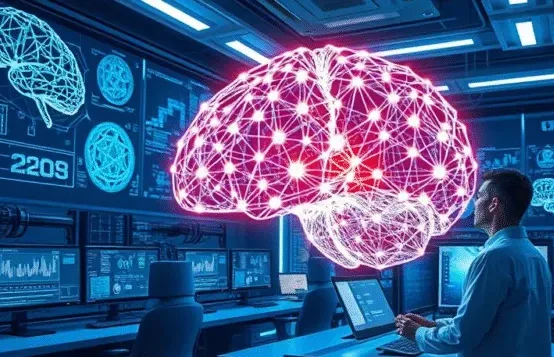




A neural network is a mechanism due to which artificial intelligence, also known as AI, learns to process data just like any other human brain would. It is safe to say that making an integrated layered structure of neurons and nodes to transfer the data.
A network of adaptive computer systems is developed, which can learn from its errors and take corrective measures to avoid them simultaneously. Due to this, artificial NNs are able to crack complex problems, patterns, and trends, recognize faces, summarize documents, and perform various such tasks efficiently.
TOC
What Is The History of Neural Network Hostile?
The origin of neural can be dated back to the year 1943, when a mathematical paper was published that described how the human brain might work. Soon after the paper was published, it caught the attention of the computer scientists to make a it for computers as well, based on the NN ( Neural-Network) of the human brain between the years 1950 to 1960.
However, the plan was dropped due to the copious amount of complex design till the 1980s, when it was picked again, and by the 1990s, a layout was developed that became the backbone of today’s era of Artificial Intelligence.
Neural network: Determine Input Layers?
As the name suggests, an artificial neural network is developed just like the human brain, AI to record and translate complex data for humans to understand and process accordingly. Just like the human brain, artificial are connected with a collection of a large number of processing units, also known as nodes.
These artificial nodes transfer the data with the help of an electrical impulse that runs through them, just like human brain neurons. Due to these advanced abilities, they are used in deep learning, which is a part of machine learning, in order to perform various tasks without the intervention of human intervention.
How Does An Artificial Neural Network Work?
A neural network works with a wide range of nodes that are further separated into three different layers for efficient processing and transferring of the data. The three different layers are mentioned below:
1. An input layer
2. A hidden layer
3. An output layer
The above-mentioned layers are the minimal requirement for the neural to work properly. In every node, a minimum of one hidden layer is required, but if the design requirement needs more than one hidden layer, then it can also be added in addition to the input layer and the output layer.
In layman’s terms, all three layers are enabled with a set of criteria that they need to satisfy in order to move forward or transfer the data to the next layer. For instance, each node is equipped with a certain mathematical formula in which each variable contains a different aspect. If the results do not satisfy the required set point, then the data stays in that particular node, and if it does, then the data is transferred to the next layer of the Ai network for further processing.
What are the different types of neural network?
The number of nodes and layers a neural network can have is endless; as such, there are numerous ways a node can correspond with other nodes. Thus, to tell an exact number is not worth it; however, we can sort them out into a few categories.
A few categories of neural are as follows:
● Deep network – hidden layers are more than one.
● Shallow Ai network – hidden layer is only one.
Another factor that one should consider is that shallow networks require less processing power and can work faster, while on the other hand deep networks require more processing power as such, they perform more complex tasks.
Below are some types of neural network that are used in the present day:
● Feed-forward AI networks – information is passed through nodes towards the forward node.
● Perceptron networks – simple and shallow networks that have an input layer and output layer.
● Multilayer perceptron- include various complexities and hidden layers to the perceptron AI.
● Modular AI networks – combine more than one node to achieve one output.
● Liquid state machine Cyber networks – the ability to connect with different nodes randomly.
● Recurrent neural AI – has a feature to go backward and allow the output of previous nodes to have an impact on the input of existing nodes.
● Residual network – identify the mapping process, which is used to move the data ahead, to combine the output of previous layers with the current layer’s output.
● Radial basis function Ai. A designated mathematical function, known as the radial basis function, is provided.
Applications of Neural network that are used in the present day are as follows:
● Image recognition – it can be used for facial recognition, image and video analysis, and medical image classification.
● Financial prediction – used to predict the trend or pattern of various stock market stocks.
● Autonomous vehicles – self-driving vehicles such as four-wheeled vehicles, drones, and cargo ships.
● Various other sectors such as signature verification, social media, weather forecasting, aerospace, electrical load and energy demand forecasting, targeted marketing, process and quality control, defence, and healthcare.
FAQs
Q1: How to determine input layers for a neural network?
Set the input layer size to the number of features in your dataset (after preprocessing); include any engineered features and ensure consistent normalization.
Q2: Neural backpropagation code Means?
In Means, use the built-in train/patternnet or implement backprop with matrix gradients: forward pass → compute loss → backpropagate errors → update weights with gradient descent.
Q3: Neural network keeps training a straight line, why?
If outputs stay linear, check for underfitting, missing non-linear activations, improper weight init, wrong loss, or unscaled inputs. Fix by adding non-linear layers, normalizing data, or tuning the learning rate.
Q4: Neural network and deep learning?
Neural AI is the basic model (layers of neurons); deep learning refers to training large, multi-layer networks with modern architectures, optimizers, and large data.
Q5: How to plot the classification boundary of a neural ?
Create a 2D grid (meshgrid), run model predictions for each point, then plot contours/filled regions with matplotlib (or equivalent) to visualize decision boundaries.
Conclusion
Neural network are the game changers in the field of artificial intelligence; as such, they can do wonders and make human life a little bit easier by performing tedious, complex work with ease.
All it needs is massive data storage abilities in order to store the data for reference and perform various jobs that require human intervention without any hassle. The need for improvement is still there as such there are still many gray areas in the field where more advancement is required. Thus, it is safe to say that the future of artificial intelligence looks brighter in the near future.