How to Build AI Agents: Stepwise Guide with Real Business Use Cases
AI Agents: What They Are and How They Work
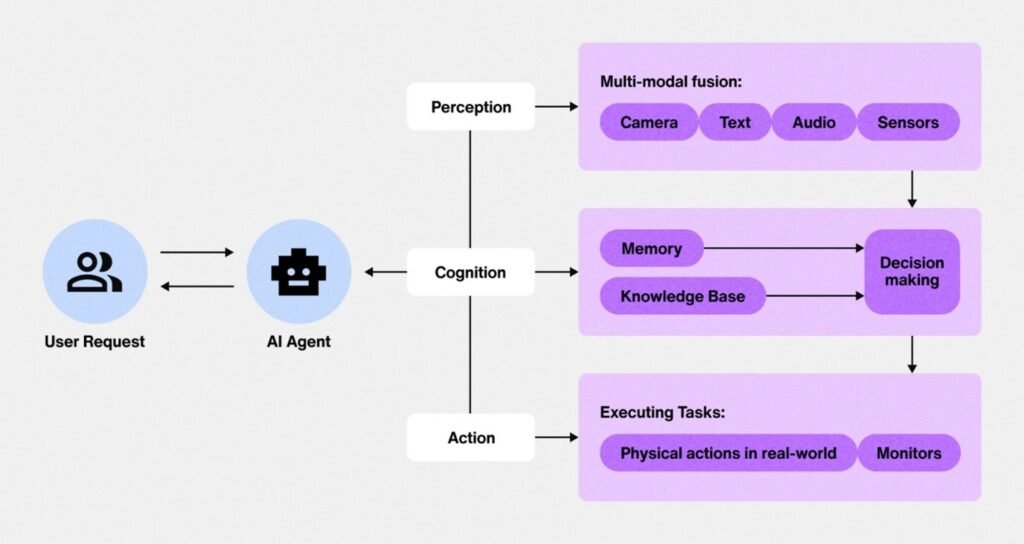
AI agents are independent systems that are capable of sensing information, thinking with memory and knowledge, and acting upon with the purpose of attaining certain objectives. In modern enterprises, AI agents play a critical role in automating workflows, supporting decisions, and executing tasks with minimal human intervention. Businesses are now turning to AI agents to automate decision-making, perform their tasks independently, and enhance their workflow. These artificial intelligence agents are perception-based, cognitive-based, memory-based, and action-based to act intelligently in unpredictable surroundings. With the knowledge of the functioning of AI agents and a step-by-step development of an agent, organizations will open the door to scalable and intelligent automation systems.
How to Build AI Agents Step by Step
AI agents are designed to work autonomously across complex systems. Modern businesses rely on AI agents to automate workflows, optimize decisions, and scale operations efficiently. As adoption grows, AI agents are becoming central to enterprise AI strategies. ai agents are widely used in enterprise systems today. Many organizations adopt ai agents to automate workflows, improve decision-making, and manage complex operations. As businesses scale, ai agents become essential components of modern AI-driven architectures.
Building AI agents requires combining data, models, memory, and tools into an autonomous decision-making system. The question that the developers, founders, and enterprises are posing is how to develop AI agents since AI is no longer a mere chatbot but a thought agent, decision-making, and acting system. AI agents have ceased to be an experiment; they are already applied in healthcare, revenue management, customer service, and industries with heavy compliance requirements.
The article describes how to build AI agents in a practical and implementation-oriented manner, focusing on how AI agents can be designed, deployed, and scaled in real-world systems. You will have an idea of what AI agents are, the internal working of AI agents, and the application of AI agents. You may ask these questions in the context of fields like AI agents in pharmacovigilance and AI agents RevOps, and they will not be advanced in an unnecessarily complex manner.
These AI agents are designed to operate autonomously while adapting to changing business and technical requirements. As AI agents continue to evolve, AI agents will become a foundational component of intelligent business systems.
Understanding What AI Agents Really Are
AI agents are intelligent software programs designed to accomplish specific objectives independently. AI agents can read between the lines, reason about information, recall previous experiences, and make decisions on the fly, unlike traditional automation, which adheres to a fixed set of rules.
Simply, AI agents monitor their surroundings, analyze the data through AI models, and act to achieve their goal. This independence of operation is what makes AI agents useful in complicated, high-volume processes in which working with humans is either costly or time-consuming. Today, when individuals refer to AI agents, they tend to refer to the systems that are driven by the huge language models alongside memory, tools, and decision logic.
Why Learning How to Build AI Agents Is Important
Understanding how to build AI agents provides organizations and individuals with a significant benefit. The AI agents employed by businesses are used to minimize the number of people working at them, enhance accuracy, and expand their operations without the need for hiring more staff.
They are utilized by developers when developing smarter applications that are not confined to mere responses. One of the areas where AI agents can be utilized in regulated fields, such as healthcare, is to process large volumes of data in a shorter time period, and with consistency. AI agents in revenue-oriented teams recognize trends that make a direct impact on growth. It makes AI agents one of the core competencies of software and operations in the future.
The Core Architecture Behind AI Agents
All successful AI agents are constructed around several key components, which collaborate with each other flawlessly. The first element is a goal that is clear. An AI agent lacking a particular goal will act in an erratic way and perform poorly. The objective may be to determine safety risks, qualifying leads or performance delivery measurements.
Secondly is the perception layer, which refers to the way the AI agent takes information. This data may be in the form of text files, databases, APIs, or live streams of events. Indicatively, AI agents in a pharmacovigilance system read adverse event reports, medical literature, and patient feedback.
The reasoning layer is the brain part of the AI agent. Here, AI models read in the inputs and use logic to determine the next course of action. Here, one can use language models, rule systems, or both. Another important component is memory.
AI agents are unable to keep context or learn things based on previous actions without memory. Memory systems enable agents to remember the past decisions, results, and user interactions and hence be more reliable as time goes by.
Lastly, the action layer helps AI agents to make decisions. This may involve issues of alerts, record updating, workflow, or report generation. This is where smartness is converted into a quantifiable business outcome.
How to Build AI Agents Step by Step
- Identify a High-Impact, Well-Defined Use Case
Begin with just one issue that can provide value that can be measured. Do not attempt to do several things concurrently. A specialised AI agent with a single specific task that is highly effective is more dependable and easier to optimize than a multi-purpose agent. - Choose the Right AI Model
AI models will depend on the kind of task. Big language models are useful in text-heavy workflows, whereas special machine learning models are in demand in classification, detection, or prediction problems. The model must relate to the problem that you are solving. - Design a Clear Agent Workflow
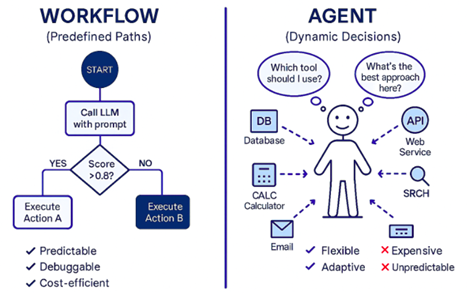
Determine the way data is entered into the system, the information processing of the AI agent, and the action of decisions made based on the decision. Proper workflow designs minimize mistakes, keep unforeseen behavior to a minimum, and simplify the process of debugging and scaling the agent. - Integrate Tools and Systems
Link AI agents with the operational tools like CRMs, databases, ticketing systems, and analytics systems. Such integrations enable AI agents to make significant decisions, and not just generate them. The RevOps AI agents, more specifically, are based on a close connection with the sales, marketing, and billing systems. - Implement Safety Guardrails
Include controls like thresholds of confidence, validation controls, and human-in-the-loop approvals on sensitive decisions. Guardrails are essential to controlled environments, and especially in such fields as pharmacovigilance, where accuracy and compliance are most important. - Test, Monitor, and Continuously Improve
Conduct extensive testing on the AI agent before its implementation and keep a check on its performance after implementation. Accuracy of the tracks, error rates, and the effects on the business. Ongoing improvement on the feedback to correct behavior and improve the results.
AI Agents in Pharmacovigilance: Improving Drug Safety
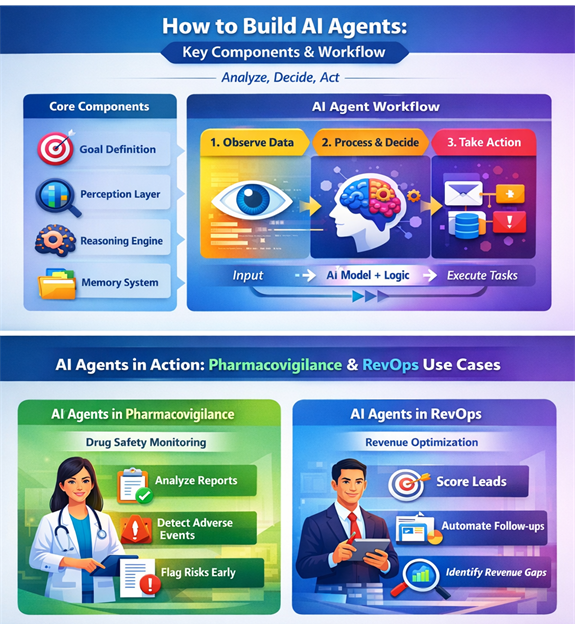
AI agents in pharmacovigilance are improving the way pharmaceutical companies check on drug safety. Historically, it was done by manually reviewing thousands of adverse event reports by safety teams, which is time-consuming and subject to human error. The ingestion and analysis of safety data in various sources are currently automated by AI agents. They identify trends, identify possible risks, and prioritize cases to be reviewed by the experts. It results in better signal detection, patient safety, and less operational work pressure on medical teams.
Due to the high regulation of pharmacovigilance, AI-based agents in this area are significantly based on guardrails and human controls, which is why they are a good illustration of responsible AI implementation. Pharmacovigilance is transforming the way drug safety is evaluated by pharmaceutical firms through the use of AI agents. Historically, thousands of adverse event reports went through safety teams, that is, manually, which is time-consuming and susceptible to human error.
The ingestion and analysis of the safety data from various sources are now automated by AI agents. They identify patterns, identify possible risks, and prioritize cases to be reviewed by the experts. This contributes to quick signal detection, enhanced patient safety, and less loading on medical teams regarding operations.
Since pharmacovigilance itself is quite a controlled field, AI agents in this field heavily depend on guardrails and human supervision. Thus, it provides one of the good examples of responsible AI implementation.
AI Agents RevOps: Driving Revenue with Intelligence
AI agents RevOps will focus on optimizing revenue operations by enhancing the sales, marketing, and customer success team decision making. These agents will examine customer behavior, pipeline information, and signals of customer engagements to uncover insights that directly influence revenue.
As a matter of fact, AI agents may be used to automatically score leads, predict churn, suggest follow-up actions, and detect revenue leakage. They also contribute to teams by operating steadily and continuously, allowing teams to focus on high-value activities as well as minimizing guesswork. The RevOps where AI agents are used at organizations generally achieve higher conversion rates, more accurate forecasting, and efficiency.
Common Mistakes to Avoid When Building AI Agents
Creating AI agents without any purpose is probably among the most frequent errors. The others include too many responsibilities assigned to the agents, and this results in unreliable performance. Neglecting edge cases and deploying agents without adequate monitoring is also a major problem, particularly in sensitive sectors. Effective AI agents are progressively developed, well-tested, and further enhanced.
Conclusion
The skill of building AI agents is going to be a fundamental aspect in contemporary technology and business. Be it the implementation of AI agents in pharmacovigilance to improve patient safety or it is the implementation of AI agents RevOps to scale the revenue, the principles are the same: clarity, control, and continuous improvement. AI agents are not concerned with overthrowing humans, it is concerned with enhancing human capacity in areas that it is most required.
Frequently Asked Questions (FAQs).
1. What are AI agents?
AI agents are smart software systems, and such software systems can keep track of information, think using AI models, and make decisions independently to achieve some goals.
2. What is the distinction between the AI agents and chatbots?
Artificial intelligence agents can make a decision, apply the tools, have the memory of the situation, and become autonomous, but chatbots only tend to respond to the postulates of a user.
5. What are the errors in creating AI agents?
The errors will most probably be non-measurable goals, an excessive number of tasks to be done by the agents, a lack of supervision, and a lack of safety barricades.
3. What is the time taken to construct the AI agents?
Simple A.I. agents can be created within a matter of weeks, whereas advanced agents, which are of enterprise quality, can take several months.
4. What is the rationale of applying AI agents to pharmacovigilance and RevOps?
Pharmacovigilance AI agents enhance drug safety by examining adverse events, whereas RevOps AI agents make AI agents optimize revenue by leading scoring, predicting churn, and automation.
5. What are the mistakes when developing AI agents?
The mistakes are likely to be vague goals, too many tasks assigned to the agents, the absence of monitoring, and the absence of safety guardrails.